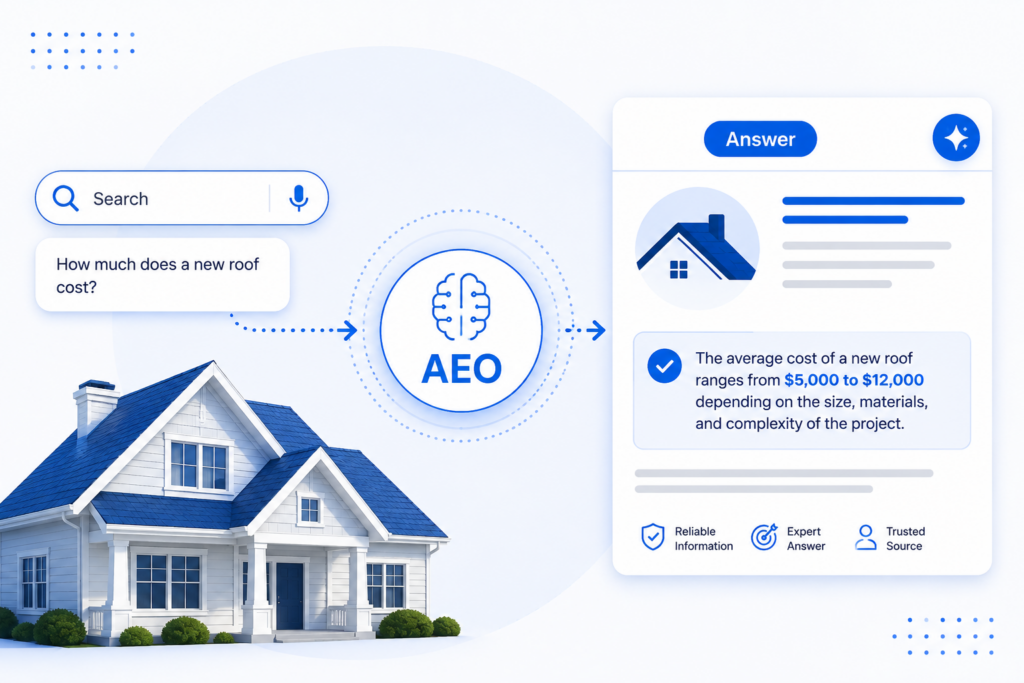
When homeowners need a roofing contractor, they no longer rely only on traditional search results. They increasingly ask conversational questions such as, “Who is a reliable roofing company near me?” or “Which roofer can help with hail damage?”
For your roofing business, this creates an important opportunity. Your company needs to be easy for modern search systems to understand, recognize, and reference when answering relevant questions.
But what makes a roofing company citable in AI search?
It goes beyond ranking for keywords. Your business needs a clear identity, useful content, consistent local information, strong expertise signals, and relevant online mentions. A well-structured digital strategy can bring these elements together while improving your overall search visibility.
Being citable means your roofing company has relevant, trustworthy, and clearly presented information that search systems can use when answering questions.
Traditional search usually provides users with a list of webpages. AI search can interpret information from different sources and provide a direct response based on the information it finds.
For example, a homeowner might ask:
“Who provides reliable roof replacement services in my area?”
To provide a useful answer, a search system needs to understand which companies offer roof replacement, where they operate, what services they provide, and what information supports their expertise.
That makes your business identity, website content, local presence, reputation, and authority important parts of your digital presence.
1. Build a Clear and Consistent Business Identity
AI search systems need to understand exactly who your roofing company is.
Your business name, website, phone number, address, service area, and primary services should remain consistent across your website and relevant third-party platforms.
Your website should clearly communicate:
Official business name
Primary roofing services
Service areas
Contact information
Business location, where applicable
Years of experience
Certifications and qualifications
Roofing specialties
A consistent business identity gives search systems useful context about your company.
For example, The Roofers SEO focuses on helping roofing businesses improve their online visibility through industry-focused SEO and digital marketing strategies.
2. Create Service-Specific Roofing Content
A general roofing page cannot answer every question a potential customer may have.
If you provide roof replacement, storm damage repair, emergency roofing, roof inspections, or other specialized services, your website should provide useful information about each service.
You can create dedicated resources covering:
Roof replacement
Storm damage roof repair
Emergency repair
Roof inspections
Metal roofing
Asphalt shingle roofing
Each page should explain what the service involves, when homeowners may need it, what the process looks like, and what questions customers commonly ask.
This gives search systems more context about your expertise while helping homeowners find information that matches their needs.
AI search is closely connected to conversational and question-based searches.
Homeowners may ask:
How do I know if my roof needs replacement?
How long does an asphalt shingle roof last?
What should I do after hail damages my roof?
Can a leaking roof be repaired?
How much does roof replacement cost?
What should I look for when hiring a roofing contractor?
Your content should answer these questions clearly and accurately.
Instead of writing only to include keywords, focus on the information homeowners genuinely need before contacting a contractor.
A useful approach is to provide a direct answer first and then explain the details. This makes your content easier for users to scan and easier for search systems to interpret.
4. Demonstrate Real Roofing Expertise
Your website should make your experience and knowledge visible.
For a roofing company, expertise can be demonstrated through practical and verifiable information such as:
Real roofing projects
Detailed service explanations
Team experience
Certifications
Manufacturer qualifications
Industry memberships
Local experience
Customer reviews
Before-and-after project information
Accurate roofing advice
Avoid filling your website with unsupported claims.
Instead, demonstrate expertise through useful information and evidence. Explain how your services work, what homeowners should know, and how your team approaches common roofing problems.
This creates a stronger information resource for both customers and search systems.
5. Strengthen Local Search Signals
Most roofing companies serve specific cities, counties, neighborhoods, or surrounding communities. That makes local relevance especially important.
Your business information should be consistent across relevant directories, business profiles, industry websites, and other legitimate sources.
Important local signals can include:
Consistent NAP information
Google Business Profile optimization
Local business listings
Service-area pages
Local content
Relevant local backlinks
Customer reviews
Industry directories
Your website should also clearly communicate where you provide services.
Instead of simply saying “We provide roof repair,” explain the areas you serve and the types of roofing problems you solve there.
Your website should not be the only place where your roofing company appears.
Relevant third-party mentions can provide additional context about your company.
Potential sources include:
Local business directories
Roofing industry publications
Manufacturer websites
Local chambers of commerce
Community organizations
Home-improvement websites
Local news websites
Professional associations
The goal is not to create hundreds of low-quality listings.
Instead, focus on relevant and legitimate sources that reinforce your business identity, services, location, and expertise.
A strong digital presence is built from multiple useful signals rather than one isolated webpage.
7. Use Genuine Customer Reviews
Reviews can provide more than a star rating.
Detailed customer feedback can naturally describe the services your company provided and the customer’s experience.
For example, a genuine review might mention:
Roof replacement
Hail damage repair
Roof inspection
Emergency repair
Communication
Project quality
Professional service
Never create fake reviews or manipulate customer feedback.
Instead, encourage genuine customers to share honest experiences.
Authentic reviews can provide useful context about your company and help potential customers understand what it is like to work with your business.
8. Make Your Website Easy to Understand
Even excellent information can lose its value when a website is poorly organized.
Your roofing website should use a logical structure with:
Clear H1 and H2 headings
Short paragraphs
Descriptive subheadings
Bullet points
FAQ sections
Internal links
Dedicated service pages
Helpful supporting articles
Important answers should not be buried inside long blocks of text.
Use clear headings and concise sections to make information easy for homeowners to find.
Your internal linking structure should also connect related services, educational content, and location information.
A strong mobile experience is equally important because many homeowners search for contractors from their phones. Your content can also be supported by a focused approach to mobile SEO for roofing lead generation.
9. Connect Services, Locations, and Expertise
AI search needs context.
Your website should clearly establish the relationship between your company, services, locations, and areas of expertise.
For example:
Roofing Company → Roof Replacement → Residential Roofing → Local Service Area
Another example could be:
Roofing Company → Storm Damage Repair → Hail Damage → Local Homeowners
This contextual approach makes your website easier to understand.
Instead of treating every page as an isolated piece of content, create a connected website where service pages, location pages, blog posts, and company information support one another.
10. Build a Strong Search Foundation
AI search visibility does not replace traditional SEO.
Your website still needs relevant content, technical optimization, local signals, authority, and a clear structure.
A comprehensive strategy can support areas such as:
Keyword research
Local optimization
Service-page optimization
Technical SEO
Content development
Internal linking
Local citation building
Link building
Reputation signals
Structured data
Search-focused content optimization
The goal is to create a website that is useful to homeowners while making your business information clear and accessible to modern search systems.
How Can You Make Your Roofing Company More Citable?
Start by reviewing your online presence from the perspective of a potential customer.
Ask yourself:
Is my business information consistent across the web?
Does my website clearly explain my main services?
Do my pages answer real homeowner questions?
Are my service areas easy to understand?
Are my experience and qualifications clearly presented?
Does my company receive legitimate third-party mentions?
Are my customer reviews genuine and relevant?
Is my website organized around clear topics and services?
If several answers are no, there may be opportunities to strengthen your overall search presence.
Final Thoughts
Becoming citable in AI search is about much more than adding keywords to your website.
Your company needs a clear digital identity, useful service information, consistent local signals, genuine reputation signals, relevant third-party references, and content that answers real homeowner questions.
When these elements work together, your website becomes a stronger source of information about your roofing company.
A strategic approach to search optimization can help you build the content, local relevance, authority, and technical foundation needed for an evolving search environment.
If you want to discuss your business goals and explore a customized strategy, you can Contact The Roofers SEO Team.
1. What makes a roofing company citable in AI search?
A roofing company becomes more citable when its business identity, services, location, expertise, reviews, and supporting information are clearly presented and consistently represented across relevant online sources.
2. Does traditional SEO still matter for AI search?
Yes. Traditional SEO provides important foundations such as website accessibility, relevant content, technical structure, local visibility, and authority. These elements can support visibility across evolving search experiences.
3. Should roofing companies create separate service pages?
Dedicated pages for important roofing services can help explain specific expertise and address different customer search intents. Each page should provide genuinely useful information rather than simply repeating keywords.
4. Can customer reviews support AI search visibility?
Genuine reviews can provide additional context about a company’s services and customer experiences. Authentic reputation signals can contribute to a stronger overall online presence.
5. How can Roofing SEO Services support AI search visibility?
Roofing SEO Services can support AI visibility through technical SEO, local optimization, service-focused content, internal linking, citation building, authority development, structured information, and content designed around real customer questions.
Roofing websites often publish blog posts around individual keywords, but ranking success is not always about how many keywords you target. Topical depth helps you build comprehensive coverage around the roofing services, questions, problems, and locations your customers care about. When your website connects these subjects logically, your Roofing SEO Services strategy can create stronger topical relevance, improve user experience, and support visibility across traditional and AI-driven search.
For roofing contractors, this means going beyond articles such as “roof repair tips” or “roof replacement costs.” You need a connected content ecosystem that demonstrates knowledge across the complete customer journey—from identifying a roofing problem to researching solutions and choosing a local contractor.
Topical depth refers to how comprehensively your website covers a particular subject and its closely related concepts.
For example, if roof replacement is one of your primary services, one page about roof replacement may not answer every question a homeowner has. A deeper content strategy could cover:
Signs that a roof needs replacement
Roof replacement costs
Roofing material options
Roof replacement timelines
Roof replacement preparation
Roof warranties
Roof replacement versus roof repair
Storm-damaged roof replacement
Roof replacement maintenance
Local roof replacement services
These subjects are connected. Together, they create a clearer picture of your expertise.
Topical Depth vs. Publishing More Content
Publishing dozens of unrelated articles does not automatically create topical authority.
A website with 50 disconnected roofing articles may provide less useful context than a website with 20 strategically connected resources covering its most important services in depth.
A strong roofing website should create relationships between its:
Service pages
Blog posts
FAQs
Location pages
Case studies
Guides
Industry resources
For example, a roof repair service page can connect to articles about roof leaks, emergency repairs, storm damage, repair costs, inspection requirements, and repair-versus-replacement decisions.
This gives both users and search engines more context about what your business actually specializes in.
Why Is Topical Depth Important for Roofing Websites?
Topical depth can support several important parts of your SEO strategy.
Builds Topical Authority
When your website consistently covers related roofing subjects, it can demonstrate a broader level of knowledge around those subjects.
Instead of creating a single page targeting “roof repair,” you can develop useful supporting resources that answer the questions customers naturally ask before, during, and after a repair.
This creates a more complete information structure.
Supports Better Search Visibility
Homeowners do not all search for the same thing.
One person may search:
“roof repair near me”
Another may search:
“how do I know if my roof is leaking?”
Another may search:
“how much does roof replacement cost?”
And another may search:
“roof repair or replacement which is better?”
A topically deep website has an opportunity to address these different search intents rather than depending on one keyword.
Helps Match Different Search Intent
Your content should address different stages of the customer journey.
Informational intent:
“What causes roof leaks?”
Commercial investigation:
“How much does roof replacement cost?”
Service intent:
“Roof replacement contractor near me”
Local intent:
“Roof repair company in [city]”
Problem-based intent:
“What should I do after hail damages my roof?”
Topical depth allows your website to provide useful content across these different needs.
Creates More Qualified Traffic
Traffic alone is not the main objective for a roofing company.
The more useful question is:
Does your content attract homeowners who may actually need your services?
Detailed content around real roofing problems can attract visitors who are already researching repairs, replacements, inspections, storm damage, and other services.
Topical depth works best when your content is organized around meaningful relationships.
Connect Core Services With Supporting Topics
Suppose your main service is roof replacement.
Instead of publishing unrelated roofing articles, build supporting content around the service:
Roof Replacement
→ When should you replace a roof?
→ Roof replacement cost
→ Roof replacement materials
→ Roof replacement timeline
→ Roof repair vs. replacement
→ Storm damage replacement
→ Roof replacement warranties
→ Roof replacement maintenance
Each supporting topic can provide additional context while directing users toward the appropriate service page.
Strengthen Internal Linking
Internal linking is another important part of topical depth.
When related pages link to each other naturally, users can move from an informational resource to a relevant service page without having to search your website again.
For example:
Roof Leak Causes → Roof Inspection → Roof Repair → Local Roofing Service
This creates a logical journey instead of a collection of isolated pages.
Expand Semantic Relevance
A strong roofing article should naturally discuss concepts that belong to the subject.
For example, a detailed roof repair resource might naturally mention:
Leaks
Shingles
Flashing
Underlayment
Water damage
Inspections
Storm damage
Roof age
Repair costs
Replacement considerations
You do not need to force every related phrase into the article. The objective is to provide genuinely useful coverage.
What Does a Topically Deep Roofing Website Look Like?
A topically deep roofing website normally has several layers of content working together.
Core Roofing Service Pages
Your primary services should have dedicated, comprehensive pages.
Examples include:
Roof Repair
Roof Replacement
Roof Installation
Roof Inspection
Storm Damage Roofing
Commercial Roofing
Emergency Roofing
These pages should clearly explain what you offer and who you serve.
Supporting Educational Content
Blog content can answer questions that are too specific or educational for your primary service pages.
For example:
How do you know if your roof needs repair?
What causes roof leaks?
How long does a roof replacement take?
What should you do after hail damage?
How often should a roof be inspected?
How long do different roofing materials last?
These articles can support your broader service topics.
Local Content
Topical depth should also include local relevance.
A roofing company serving multiple areas can create useful location-focused resources that explain:
Services available in the area
Common roofing concerns
Weather-related roofing issues
Local customer questions
Relevant service options
The goal should be to provide genuine local value rather than simply replacing a city name throughout the same page.
How Can Roofers Build Topical Depth Around One Service?
Let’s take roof repair as an example.
Instead of having only one roof repair service page, you can build a content cluster around it.
Core Page
Roof Repair Services
Supporting Topics
Common roof problems
Causes of roof leaks
Emergency roof repair
Storm-related roof damage
Damaged shingles
Roof inspection before repair
Roof repair costs
Roof repair versus replacement
Roof maintenance
Signs of serious roof damage
Local roof repair services
Questions to ask a roofing contractor
These pages should not exist independently.
They should support one another through contextual internal links.
For example, an article about roof leaks can reference the roof repair service when professional assistance is needed. An article about roof repair versus replacement can connect users to both relevant services.
For example, your website should clearly communicate:
Who you are
What roofing services you provide
Where you operate
Which roofing problems you solve
What questions you can answer
What makes your service relevant to customers
Answer Complex Roofing Questions
Topical depth gives you the opportunity to answer questions that combine several concepts.
Instead of writing only:
“What Is Roof Repair?”
you can address:
“How Can You Tell Whether Storm Damage Requires Roof Repair or Replacement?”
The second question connects storm damage, inspection, repair, replacement, and decision-making.
Create Consistent Website Context
Your service pages, blog articles, FAQs, and location content should not contradict one another.
They should collectively reinforce the same business information and service expertise.
For example, your mobile SEO strategies for roofing lead generation content can complement a broader topical strategy by connecting mobile search behavior, local intent, technical optimization, and lead generation.
What Are the Signs Your Roofing Website Lacks Topical Depth?
Your website may need a deeper content strategy if:
Your blog contains many unrelated topics.
Important roofing questions remain unanswered.
Your service pages have little supporting content.
Blog posts rarely link to relevant service pages.
Several pages target almost identical topics.
Your website focuses heavily on broad keywords.
Local content provides little unique value.
Your content does not demonstrate practical roofing knowledge.
Informational content has no clear connection to your services.
These problems can make your website feel like a collection of individual pages instead of a complete roofing resource.
How Can Roofing SEO Services Improve Topical Depth?
A strategic Roofing SEO Services approach can help turn disconnected content into a structured topical ecosystem.
Identify Content Gaps
Start by identifying questions, services, subtopics, and local subjects that your website does not currently cover.
This helps you understand where additional content can provide genuine value.
Build Topic Clusters
Group content around your most important revenue-generating services.
For example:
Roof Replacement
→ Cost
→ Materials
→ Timeline
→ Signs of replacement
→ Repair vs. replacement
→ Storm damage
→ Maintenance
This is more strategic than publishing random blog topics.
Map Search Intent
Each page should have a clear purpose.
Ask:
What does the person searching this topic actually want to know or do?
That question can help determine whether the page should be informational, commercial, local, or service-focused.
Improve Internal Linking
Use descriptive anchor text that tells users what they will find on the linked page.
Instead of:
“Click here to learn more.”
Use descriptive phrases such as:
“professional roofing SEO services”
or
“mobile SEO strategies for roofing lead generation.”
Descriptive anchor text provides more context and creates a clearer relationship between pages.
Strengthen Existing Content
Topical depth does not always mean publishing something new.
Sometimes the best opportunity is improving an existing article by:
Adding missing sections
Answering additional questions
Improving internal links
Updating outdated information
Connecting the article to relevant services
Removing unnecessary repetition
How Should Roofers Create a Topical Content Strategy?
You can build a stronger content ecosystem with a structured process.
Step 1: Define Your Core Roofing Services
List the services that are most important to your business.
Step 2: Identify Customer Problems
Think about the actual problems homeowners experience.
Leaks, storm damage, aging roofs, missing shingles, poor ventilation, and replacement decisions can all become useful content themes.
Step 3: Map Related Questions
For every core service, identify the questions customers ask before contacting a contractor.
Step 4: Group Related Topics
Organize questions into logical clusters.
Step 5: Create Strong Core Pages
Your primary service pages should provide comprehensive information about the service.
Step 6: Develop Supporting Content
Create detailed articles that answer specific questions around each core service.
Step 7: Connect the Pages
Use relevant internal links to create logical relationships between your service pages and supporting resources.
Step 8: Add Local Relevance
Connect your services with the locations and customers you actually serve.
Step 9: Review and Expand
Regularly identify content gaps and improve existing resources instead of constantly creating new pages.
Common Topical Depth Mistakes Roofers Should Avoid
1. Writing Only for Keywords
A keyword should guide your content, not control every sentence.
2. Publishing Thin Articles
Short articles that provide little useful information may leave important questions unanswered.
3. Publishing Unrelated Topics
A roofing website does not need to publish every possible home-improvement topic.
Stay relevant to your services and audience.
4. Overusing Exact-Match Keywords
Repeating the same phrase excessively can make content unnatural.
Use related terminology naturally.
5. Ignoring Supporting Questions
Your primary service may have dozens of questions surrounding it. Ignoring those questions creates content gaps.
6. Poor Internal Linking
Even good content becomes less useful when related pages are difficult to discover.
7. Creating Duplicate Location Content
Local SEO content should provide meaningful local information rather than simply changing city names.
8. Forgetting Existing Content
Your older articles may already have search visibility and backlinks. Improving them can be more valuable than starting from zero.
Topical Depth vs. Keyword Density: What’s the Difference?
Topical Depth
Keyword Density
Covers a subject comprehensively
Focuses on keyword repetition
Connects related concepts
Focuses mainly on specific phrases
Addresses multiple search intents
Often focuses on one search phrase
Supports a broader content ecosystem
Does not create authority by itself
Prioritizes relevance and usefulness
Can result in unnatural writing
For modern roofing SEO, the objective should be to provide comprehensive and useful information rather than repeatedly inserting the same keyword.
How Can Topical Depth Help Generate More Roofing Leads?
SEO should ultimately support business growth.
A homeowner may discover your website through an informational article before they are ready to contact a contractor.
For example:
Search → Educational Article → Related Roofing Service → Contact → Lead
A detailed article about roof leaks can introduce the problem.
An internal link can take the visitor to your roof repair service.
The service page can explain your solution.
A clear CTA can then encourage the visitor to request an estimate or contact your team.
This makes your content strategy part of the customer journey rather than simply a traffic-generation exercise.
Frequently Asked Questions About Topical Depth and Roofing SEO
What is topical depth in SEO?
Topical depth is the extent to which a website comprehensively covers a subject and its related questions, services, problems, and concepts. For roofing companies, this means creating connected content around important services instead of publishing isolated articles.
Why is topical authority important for roofing websites?
Topical authority helps demonstrate comprehensive knowledge around important roofing subjects. A website that covers related services, customer questions, local needs, and supporting topics can provide stronger context than one that focuses on individual keywords alone.
How many topics should a roofing website cover?
There is no universal number. Your content coverage should depend on your services, locations, customer questions, and business priorities. The goal is to cover important subjects thoroughly without creating unnecessary or unrelated content.
Does topical depth improve roofing website rankings?
Topical depth can support relevance, content quality, and a clearer website structure, but it does not guarantee rankings. Search visibility depends on many factors, including content quality, technical SEO, competition, links, authority, local signals, and user experience.
How can Roofing SEO Services improve topical depth?
A strategic Roofing SEO Services approach can identify content gaps, organize topic clusters, improve internal linking, optimize existing pages, map search intent, and develop supporting content around your most important roofing services.
Build Deeper Topical Authority for Your Roofing Business
Topical depth is not about publishing as many roofing articles as possible. It is about creating useful, connected, and comprehensive coverage around the services and questions that matter to your customers.
Your service pages should form the foundation. Supporting articles should answer related questions. Internal links should connect these resources. Local content should reinforce your service areas. And your overall website should clearly communicate your roofing expertise.
When these elements work together, your website becomes more than a collection of keyword-targeted pages. It becomes a structured roofing resource designed to serve users, search engines, and evolving search experiences.
If your website has content but lacks a clear topical structure, now is a good time to identify the gaps and build a more strategic content ecosystem.
The way homeowners search for roofing companies is changing. Instead of relying only on short searches such as “roofer near me” or “roof repair company,” potential customers increasingly use complete questions to understand problems, compare services, and decide what to do next.
Questions such as “How do I know if my roof needs replacement?”, “What should I do after hail damages my roof?”, and “How often should my roof be inspected?” reveal valuable information about customer intent.
This makes frequently asked questions more important for roofing websites.
A well-developed FAQ section can answer customer concerns, strengthen topical relevance, provide useful context, and make information easier for search systems to understand. For roofing businesses investing in Roofing SEO Services, FAQ content can become a useful part of a broader strategy for traditional search and AI-driven discovery.
However, simply adding a long list of questions will not automatically make a roofing company appear in AI search results. The real opportunity comes from creating accurate, useful, clearly structured answers that connect naturally with your services, expertise, locations, and customer needs.
Why Are FAQs Important for Roofing Websites?
Roofing is a question-driven industry.
Homeowners often have concerns before they are ready to contact a contractor. They may notice missing shingles, water stains, moss growth, storm damage, or an aging roof but remain uncertain about the right solution.
An FAQ section gives your roofing website an opportunity to address those concerns directly.
For example, you could answer questions such as:
How often should a roof be inspected?
What are the signs of roof damage?
Should I repair or replace my roof?
How long does a roof replacement take?
Can hail damage be repaired?
What should I do if my roof starts leaking?
Does homeowners insurance cover storm damage?
These questions represent real customer concerns rather than artificial keyword variations.
When your answers are accurate and useful, visitors can find important information without navigating through several pages. At the same time, your website provides additional context about your services and areas of expertise.
That makes FAQs useful as part of a broader content strategy.
AI-powered search experiences need to understand relationships between questions, answers, businesses, services, problems, and locations.
A clearly written FAQ can contribute to those relationships through natural language.
Consider a roofing company that provides storm-damage inspections and repairs. Instead of repeatedly inserting the same keyword, the website could answer:
“What should I do if hail damages my roof?”
A useful response could explain immediate safety considerations, visible signs of damage, the importance of professional inspection, and potential repair options.
That contextual connection is more meaningful than repeating a keyword throughout a page.
The objective should be to make your expertise understandable to both potential customers and modern search systems.
Use Question-Based Content Around Search Intent
Not every roofing question represents the same type of search intent.
Some questions are purely informational, while others indicate that a homeowner may be closer to contacting a contractor.
Informational Questions
These help customers understand a roofing problem.
Examples include:
What causes roof leaks?
How long do asphalt shingles last?
How can I identify storm damage?
Why are shingles curling?
Service-Related Questions
These connect a problem with a particular service.
Examples include:
When should I schedule a roof inspection?
What does a roof replacement include?
Can damaged shingles be replaced individually?
When is roof repair appropriate?
Local Questions
These establish geographic relevance.
Examples include:
Do you provide roof repair in my area?
What roofing services do you offer in my city?
How quickly can a local roofer inspect storm damage?
Decision-Making Questions
These help customers evaluate their options.
Examples include:
Should I repair or replace my roof?
What should I look for in a roofing contractor?
How long should a professional roof replacement take?
What questions should I ask before hiring a roofer?
A strong FAQ strategy considers these different forms of intent rather than creating questions solely to place keywords on a page.
Write Direct Answers Before Adding Extra Detail
One of the most important principles for FAQ content is clarity.
If the question is:
“How often should a roof be inspected?”
Do not make the reader search through a lengthy introduction before reaching the answer.
Start directly:
A roof should generally be inspected at least once a year and after significant storms, although the appropriate schedule can vary depending on the roof’s age, condition, materials, and local weather.
You can then provide additional information about warning signs, inspection considerations, and situations where professional assistance may be appropriate.
This structure benefits readers because they receive the answer quickly.
It also creates a clearer information hierarchy for search systems to interpret.
For roofing businesses adapting to conversational search, direct question-and-answer formatting can therefore complement broader content development.
Connect FAQs With Your Main Roofing Services
FAQs should not exist as isolated blocks of text.
They should support the larger structure of your website.
For example, a roof replacement page could answer questions about:
Replacement warning signs
Expected project duration
Roofing material options
Preparation requirements
Cost considerations
Cleanup
Warranties
Post-installation maintenance
A storm-damage page could address:
Common types of storm damage
Emergency concerns
Inspection procedures
Temporary protection
Repair options
Replacement considerations
Insurance-related questions
This creates a connected content structure around each service.
Your roofing SEO strategy and search visibility should connect service information, supporting articles, local content, FAQs, trust signals, and conversion opportunities rather than treating every page as an independent asset.
Local Context Can Make Roofing FAQs More Useful
Roofing is inherently local.
A contractor may serve particular cities, counties, neighborhoods, or service areas. Weather conditions, property types, building practices, and common roofing problems can also vary between markets.
That makes local context useful when it genuinely adds information.
Instead of creating repetitive questions such as:
“Do you provide roof repair in Dallas?”
followed by nearly identical versions for every nearby city, develop useful location-specific questions.
For example:
“What roofing problems are common in this area after severe storms?”
The answer could discuss relevant weather conditions, common forms of roof damage, inspection considerations, and services available in that market.
This gives the content a genuine purpose.
Local relevance can also be strengthened by maintaining accurate business information, clearly identifying service areas, and creating useful location-focused resources.
FAQs Should Demonstrate Real Roofing Expertise
AI search visibility should not be approached as a purely technical exercise.
The underlying content still needs to demonstrate knowledge and credibility.
Your answers can become more valuable when they include practical information based on genuine roofing experience.
For example, instead of simply saying:
“Roof leaks should be repaired quickly.”
explain what homeowners may actually notice:
Water stains on ceilings
Damp insulation
Missing or damaged shingles
Dripping around skylights
Moisture near roof penetrations
Damaged flashing
Signs of previous water intrusion
You can then explain why a professional assessment may be appropriate.
Original project insights, photographs, customer questions, inspection knowledge, clearly explained processes, and detailed service information can all contribute to stronger topical depth.
This is where specialized Roofing SEO Services can move beyond basic keyword placement and focus on making the entire website more useful, trustworthy, and understandable.
Avoid These Common FAQ Mistakes
Not every FAQ improves a website.
Several approaches can reduce the value of your content.
1. Writing Questions Only for Keywords
Do not create unnatural questions simply because a keyword has search volume.
Every question should have a clear customer purpose.
2. Publishing Generic Answers
An answer such as “Contact a professional roofer for help” provides very little information.
Explain the issue, relevant warning signs, possible options, and appropriate next steps.
3. Creating Duplicate Questions
Avoid asking the same question in slightly different wording across multiple pages.
4. Adding Excessive FAQs
More questions do not automatically mean better content. Focus on concerns that are genuinely relevant to your customers and services.
5. Ignoring the Rest of the Website
FAQs cannot compensate for weak service pages, unclear business information, poor technical performance, or limited evidence of expertise.
The FAQ section should strengthen the website’s overall content ecosystem.
How Can Roofing SEO Combine FAQs With AI Search Optimization?
A comprehensive search strategy can bring several elements together.
Your website can combine:
Service-focused pages
Local SEO
Question-based content
FAQ sections
Internal linking
Customer reviews
Project examples
Clearly defined service areas
Technical SEO
Answer-focused content
Geographic relevance
Strong conversion paths
The purpose is to create a consistent relationship between your business, services, locations, expertise, and customer problems.
A Premier Roofing SEO Company should therefore look beyond individual keyword rankings and consider how each content asset contributes to the overall search presence of a roofing business.
When FAQs are connected to useful service pages and supporting resources, they become part of a broader topical structure rather than simply an isolated list of questions.
This gives readers a predictable path through the information.
It also creates stronger relationships between related topics.
Internal links should serve a purpose. When you mention a service or supporting topic, link to the relevant page using descriptive anchor text instead of generic phrases such as “click here.”
For example:
Explore professional roofing SEO solutions
is more descriptive than:
Click here
This approach improves usability while helping establish context between connected pages.
Strengthen Your Roofing Search Visibility
FAQs can be a valuable part of an AI-search-ready content strategy, but they work best when supported by strong local relevance, useful service information, technical optimization, internal linking, and genuine expertise.
If your roofing website needs a structured approach to improving its search presence, The Roofers SEO can help develop content and SEO strategies around your business goals.
They can support AI search visibility by providing clear answers to relevant customer questions. Well-written FAQs can also establish relationships between roofing services, problems, locations, and expertise. However, FAQs are only one component of a broader search optimization strategy.
2. What questions should a roofing company include in its FAQ section?
Focus on genuine customer concerns related to roof repairs, replacement, inspections, storm damage, materials, maintenance, costs, timelines, service areas, and hiring a contractor. Questions should reflect your actual services and customer needs.
3. Should roofing FAQs include local keywords?
Local context can be useful when it provides meaningful information. Rather than repeating city names unnaturally, create questions and answers that explain relevant services, locations, weather-related concerns, and customer needs in the areas you actually serve.
4. Can FAQs help with conversational search?
Yes. Question-based content naturally matches conversational searches because people often phrase their searches as complete questions. Direct, accurate answers can make information easier for visitors and search systems to understand.
5. How long should a roofing FAQ answer be?
There is no universal word count. Start with a direct answer and add enough context to address the question properly. Simple questions may require only a short paragraph, while more complex topics may need additional explanation or a link to a detailed service page.
6. Should every roofing page have an FAQ section?
Not necessarily. FAQs should be included when they genuinely help users understand the service or topic. Questions should be specific to the page instead of being copied across multiple URLs.
7. Can FAQs generate roofing leads?
FAQs can contribute to lead generation by addressing concerns that may prevent visitors from contacting a contractor. When answers are followed by relevant service information and clear calls to action, they can help move visitors from research toward an inquiry.
Final Thoughts
Roofing FAQs are more than a collection of questions at the bottom of a webpage. When developed strategically, they can strengthen topical coverage, address conversational searches, clarify local services, demonstrate expertise, and guide potential customers toward the next step.
The key is quality and context.
Create answers based on real customer concerns. Keep information accurate and direct. Connect questions with relevant services and locations. Support important information with genuine expertise. Use internal links where they help visitors continue their research, and provide a clear CTA when someone is ready to take action.
For roofing businesses adapting to changing search behavior, FAQs can become one useful component of a broader strategy focused on visibility, relevance, trust, and qualified leads.
Every completed roofing project represents more than another job in your portfolio. It can become valuable evidence of your experience, expertise, service capabilities, and local presence. When you document those projects strategically, they can also contribute to a stronger website structure and broader search visibility.
For roofing companies, this creates an important opportunity. Instead of treating completed projects only as photographs on a gallery page, you can turn them into useful content that answers homeowner questions, demonstrates real-world experience, and strengthens connections between your services and the locations you serve.
A well-planned Roofing SEO Services strategy can help you organize these project assets into a website that communicates your expertise more clearly to both potential customers and search engines.
What Does Search Authority Mean for a Roofing Company?
Search authority is not simply about ranking for one keyword. It develops when your website consistently provides relevant, useful, and trustworthy information about your business, services, expertise, and customers’ needs.
For a roofing company, completed projects can support that authority because they demonstrate what your business actually does.
A single project may naturally cover several related topics:
Roof repair
Roof replacement
Storm damage
Roofing materials
Property types
Local service areas
Customer concerns
Roofing solutions
Project experience
When these subjects are documented accurately, your website can build stronger topical relationships instead of relying on repetitive keyword-focused pages.
Why Real Roofing Projects Matter for Search Visibility
Generic service descriptions tell customers what you claim to do.
Project content can show what you have actually done.
For example, instead of simply stating:
“We provide professional roof replacement services.”
A detailed project page could explain:
What condition the original roof was in
Why replacement was necessary
What type of roofing system was involved
Which materials were selected
What challenges the project presented
How the work was completed
Where the project took place
What the finished result looked like
This gives potential customers more useful information while giving your website additional context around your expertise.
That distinction is important because strong search content should not simply repeat what a business offers. It should demonstrate knowledge through useful, specific information.
Turn Completed Projects Into Valuable Content Assets
Not every roofing job needs its own page.
Focus on projects that provide enough unique information to be genuinely useful to homeowners. A major roof replacement, storm-damage restoration, commercial roofing project, or complex repair may offer much more content value than a simple routine service call.
A strong project page can include several core elements.
Project Overview
Start with a concise explanation of the property, service, and objective.
Roofing Challenge
Explain the original problem and why professional roofing work was required.
Recommended Solution
Describe the solution and the factors considered when choosing that approach.
Materials and Roofing System
Where appropriate, explain the roofing materials, components, or system involved.
Work Completed
Summarize the major stages of the project without overwhelming readers with unnecessary technical details.
Project Location
Include the relevant city or service area naturally when it adds useful context.
Original Project Photography
Use authentic photographs whenever possible. Before-and-after images, work-in-progress photographs, material details, and completed roof images can make the page more credible and useful.
Related Resources
Connect the project to relevant services, educational content, and other pages on your website using descriptive anchor text.
Turn Your Roofing Experience Into Search Visibility
Ready to build a stronger search presence around the roofing work you already complete?
How Roofing Projects Can Strengthen E-E-A-T Signals
Real project documentation can provide useful evidence of first-hand experience.
Consider the difference between a generic article about roof replacement and a detailed project showing how a roofing company handled an actual replacement.
The project can demonstrate:
Experience:
The company has completed real roofing work.
Expertise:
The content explains the roofing problem, solution, materials, and project considerations.
Authority:
Multiple detailed projects can demonstrate depth across the company’s services.
Trust:
Authentic photographs, clear descriptions, and transparent project information can help customers understand what to expect.
The purpose is not to artificially create authority. It is to document the expertise your company already has.
Use Local Project Information Naturally
Roofing is strongly connected to local search behavior.
Homeowners usually need a roofing company that can serve their specific location. Your completed projects can therefore provide useful geographic context when the information is genuine and relevant.
For example:
A residential roof replacement project in [City] involved removing an aging roofing system and installing a new system suited to the property’s requirements.
This is more useful than repeatedly inserting a city name into unrelated paragraphs.
Your location should support the story of the project rather than become a keyword inserted only for rankings.
Connect Roofing Projects With Relevant Services
A project page should contribute to your overall website architecture.
Suppose you publish a project about storm-damaged roofing. That page may naturally relate to:
Storm damage roofing
Roof repair
Roof replacement
Emergency roofing
Roofing inspections
Local roofing services
Those relationships create opportunities for contextual internal linking.
Instead of using anchors such as “click here” or “read more,” use descriptive phrases that explain the destination.
For example:
Learn more about Roofing SEO Services designed to strengthen your roofing company’s online visibility.
The anchor should make sense within the sentence and should accurately describe the page being linked to.
This helps users understand where the link will take them and creates a clearer relationship between related pages.
Why Internal Linking Matters for Roofing Project Content
Publishing a project page is only one part of the strategy.
You also want that page to connect logically with the rest of your website.
A useful internal-linking structure could connect:
Project Page → Relevant Service Page
Project Page → Related Educational Article
Service Page → Relevant Project Example
Blog Article → Related Service
This creates a connected content ecosystem instead of a collection of isolated pages.
It also gives visitors natural opportunities to move from informational content toward relevant services.
Can Roofing Projects Support AI Search Visibility?
Modern search systems increasingly interpret relationships between topics, businesses, services, locations, and questions.
Detailed project content can provide useful context around those relationships.
Imagine a homeowner searching for:
“Who handles storm-damaged asphalt shingle roofs in my area?”
A detailed project page could establish connections between:
Roofing company
Storm damage
Asphalt shingles
Roof repair
Roof replacement
Service location
Completed work
Roofing expertise
This does not mean a project page guarantees visibility in AI-generated answers.
Instead, the benefit comes from giving search systems more complete and understandable information about your business and its experience.
That makes project content relevant to broader strategies involving SEO, AEO, GEO, local search, and E-E-A-T.
Build Stronger Topical Connections From One Project
A single roofing project can provide ideas for multiple useful pieces of content.
For example, a hail-damage roof replacement could connect with content about:
How to identify hail damage
When roof repair is appropriate
When replacement may be necessary
Roofing materials
Roof inspections
Storm preparation
Post-storm homeowner questions
Local roofing services
This approach allows you to build content around real customer needs rather than creating unrelated articles simply to target additional keywords.
Over time, those connected topics can create a more comprehensive resource around your roofing services.
What Should a Roofing Project Page Include?
A professional roofing project page can follow this structure:
1. Project Title
Clearly identify the service and project type.
2. Project Summary
Explain what the customer needed and what the roofing team completed.
3. Roofing Challenge
Describe the original condition or problem.
4. Recommended Solution
Explain the selected approach and why it was appropriate.
5. Materials and Methods
Include useful material or system information where relevant.
6. Project Location
Mention the appropriate location naturally.
7. Authentic Project Photos
Show the actual work rather than relying entirely on stock imagery.
8. Completion Details
Explain what was completed and any relevant final considerations.
9. Related Services
Connect the project to relevant service pages using descriptive anchor text.
10. Customer FAQs
Answer questions homeowners are likely to have about similar roofing situations.
This structure makes the page useful for both customers and search engines.
Strengthen Your Roofing Website
Your completed roofing projects already demonstrate valuable experience. The next step is presenting that experience strategically online.
If every page uses the same description with only the city or project type changed, visitors receive little additional value.
Make each project genuinely different.
2. Using Only Stock Images
Stock photography can support general website design, but authentic project photography provides stronger evidence of actual work.
3. Providing Photos Without Context
A photo gallery alone does not explain what happened during the project.
Describe the problem, solution, materials, and completed work.
4. Overusing Roofing Keywords
Repeating the same phrase in every heading and paragraph can make the content unnatural.
Use related terminology where it genuinely helps explain the subject.
5. Creating Thin Location Content
Simply replacing one city name with another does not create meaningful local content.
Use genuine project information and location-specific details.
6. Leaving Project Pages Isolated
Connect project pages with relevant service pages and educational resources.
A connected website is easier for visitors to navigate and provides clearer relationships between related topics.
How Roofing SEO Services Can Turn Projects Into Search Assets
Your roofing projects are the source material.
A strategic SEO process can help determine how that material should be organized and connected across your website.
A comprehensive approach can include:
Project content planning
Search-intent research
Keyword mapping
Internal-linking strategy
Local SEO optimization
Service-page connections
Content gap analysis
E-E-A-T-focused content development
Technical SEO
Ongoing content improvements
The goal is not to turn every completed project into a keyword-heavy landing page.
The goal is to create useful content that accurately represents your company’s experience and connects that experience with the questions your potential customers are asking.
Build Search Authority From the Work You Already Do
Your completed roofing projects contain valuable information about the problems you solve, services you provide, locations you serve, and expertise you have developed.
When that information is documented with original details, authentic images, useful explanations, and logical internal links, project content can become much more than a portfolio.
It can become part of a broader website strategy designed to communicate your roofing expertise clearly.
That is where Roofing SEO Services can help you transform real-world project experience into structured, useful search content.
They can contribute to SEO by expanding relevant topical content, demonstrating first-hand experience, providing useful local context, and creating opportunities for contextual internal linking.
What should a roofing project page include?
Include the project type, roofing problem, location, solution, materials where relevant, work completed, authentic photographs, and useful related information.
How do roofing projects support local SEO?
Genuine project locations can provide relevant geographic context while showing potential customers that your company has experience serving their area.
Can project content help with AI search visibility?
Detailed project content can provide search systems with clearer information about your company, services, locations, and experience. It cannot guarantee inclusion in AI-generated results.
How often should roofing companies publish project pages?
There is no fixed frequency. Prioritize significant projects that contain enough original information to provide genuine value rather than publishing large numbers of repetitive pages.
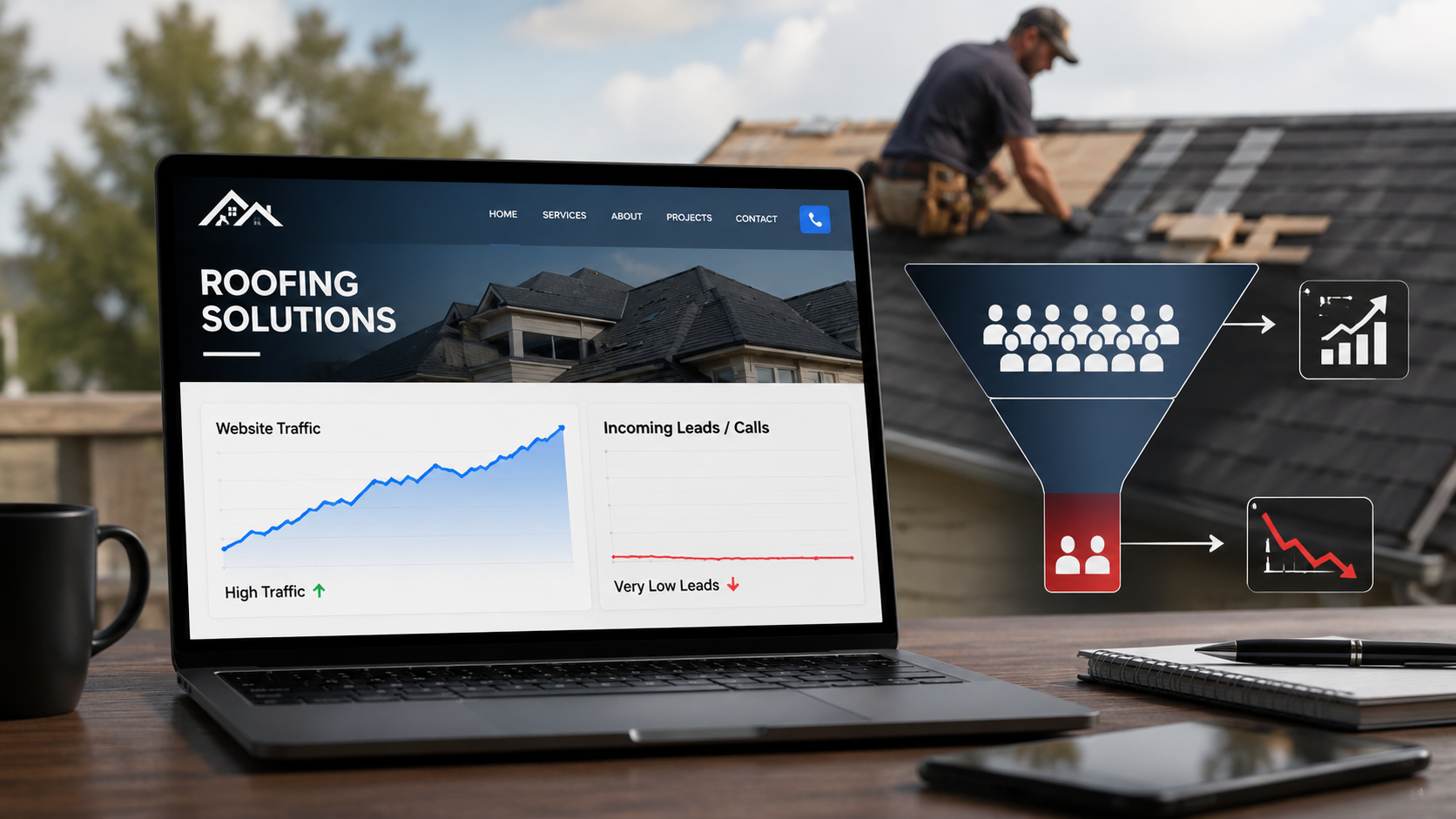
Getting traffic to your roofing website is a positive sign, but traffic alone does not grow your roofing business. If hundreds of people visit your website and very few call, request an estimate, or submit a contact form, something is missing between visibility and conversion.
Your website may be attracting the wrong audience, targeting weak search intent, creating a poor user experience, or failing to build enough trust. In other cases, the problem may be that your pages answer informational questions but do not give visitors a clear reason to take the next step.
The good news is that you do not always need more traffic. Sometimes, you need to make better use of the traffic you already have.
Traffic Does Not Always Mean Buyer Intent
One of the first things you should examine is why people are visiting your website.
Traffic Does Not Always Mean Buyer Intent
A visitor searching for “how to clean roof gutters” may not be looking for a roofing contractor. Someone searching for “roof replacement contractor near me” has a much stronger commercial intent.
This difference matters.
If your SEO strategy focuses heavily on broad informational keywords, you may generate impressive traffic numbers without generating many qualified leads.
Your roofing content should address different stages of the customer journey:
Informational searches for people researching roofing problems
Commercial searches from people comparing roofing companies
Local searches from customers looking for contractors nearby
Transactional searches from people ready to request an estimate
A strong strategy attracts visitors at each stage while giving high-intent prospects clear opportunities to contact you.
Are You Attracting the Right Local Customers?
Roofing is a local service. A visitor from another state does not help much if your company only serves a specific service area.
Your website should clearly communicate where you provide roofing services.
Include relevant location information throughout your website without forcing city names into every sentence. Create useful service-area pages when you genuinely serve those locations, and explain the services available in each market.
For example, instead of creating a generic page that repeatedly mentions a city, create useful local content that explains:
Roofing services available in the area
Common local roofing concerns
Storm or weather-related roofing issues
Areas you serve
Local project experience
How customers can request an inspection
This helps search systems and potential customers understand your geographic relevance.
Does Your Website Clearly Explain Your Roofing Services?
A potential customer should not have to search through your website to understand what you actually do.
Your main roofing services should have dedicated, useful pages where appropriate. These may include:
Roof repair
Roof replacement
Residential roofing
Commercial roofing
Storm damage roofing
Hail damage inspection
Emergency roofing
Roof maintenance
Each service page should answer the questions a potential customer is likely to have.
What service do you provide?
Who is the service for?
Where do you provide it?
What problems can you solve?
What should the customer do next?
When your pages provide these answers clearly, visitors have less uncertainty and more reasons to contact you.
Could Weak Calls-to-Action Be Losing Your Leads?
A visitor can be interested in your roofing service and still leave without contacting you if your website does not provide a clear next step.
A generic “Learn More” button is rarely as compelling as a CTA connected to the customer’s immediate need.
Consider using relevant calls-to-action such as:
Request a Roof Inspection
Get a Roofing Estimate
Schedule a Roof Inspection
Request Storm Damage Help
Talk to a Roofing Professional
Contact Our Roofing Team
Your CTA should appear naturally where the visitor has enough information to make a decision.
Do not force the same CTA into every section. Match the call-to-action to the page and the customer’s intent.
Are You Giving Visitors Enough Reasons to Trust You?
Roofing is a major investment. Before contacting you, potential customers may want evidence that your company is legitimate, experienced, and capable of handling their project.
Your website should make important trust signals easy to find.
Consider including:
Customer reviews
Testimonials
Project photos
Before-and-after examples
Team information
Certifications
Relevant licenses or credentials
Service guarantees, when genuinely offered
Warranty information
Years of experience
Local project examples
Do not simply claim that you are the “best roofing company.” Show evidence that helps customers make an informed decision.
This is especially important when your website competes with established local roofing companies.
Is Your Website Easy to Use on Mobile Devices?
Many roofing customers will discover your business while using a smartphone. If your website is difficult to navigate on a small screen, you may lose leads even when your rankings are strong.
Check whether visitors can quickly:
Find your phone number
Tap to call
Open your service pages
Complete your contact form
Read your content
Find your service area
Request an estimate
Your website should also load efficiently and provide a straightforward navigation experience.
A beautiful website that makes customers work to find your contact information is still a conversion problem.
How Can AEO Help Your Roofing Website Generate Better Leads?
Answer Engine Optimization, or AEO, focuses on providing direct, useful answers to the questions people ask during search.
For roofing businesses, this means creating content that answers real customer questions rather than producing articles solely to insert keywords.
You might address questions such as:
How do you know when a roof needs replacement?
How long does a roof replacement take?
Can hail damage cause roof leaks?
Should you repair or replace an old roof?
How often should a roof be inspected?
What should you do after a roofing storm?
Give concise answers first, then provide useful supporting information.
The important part is connecting informational content with relevant services.
For example, an article explaining hail damage can naturally direct a reader toward your storm damage inspection service. This creates a logical path from question → answer → service → contact.
How Does GEO Support Roofing Lead Generation?
GEO, or Generative Engine Optimization, focuses on making your business information useful and understandable across modern search experiences that generate answers from multiple sources.
For a roofing company, this means building a strong information ecosystem around your:
Business
Services
Locations
Expertise
Customer experience
Projects
Reviews
Frequently asked questions
Your website should consistently explain what you do, where you operate, and the problems you solve.
Local relevance is particularly important. If your website clearly connects your roofing services with the communities you genuinely serve, it becomes easier for both customers and search systems to understand your business context.
GEO should not mean stuffing content with locations or repeating keywords. The goal is to create clear, trustworthy, locally relevant information.
How Can AI-Supported Search Change Roofing Lead Generation?
Search behavior is becoming more conversational. Customers may describe a roofing problem in natural language rather than searching for one short keyword.
For example, a homeowner might ask:
“What should I do if I notice a ceiling stain after a heavy storm?”
Your content should be able to address questions like this with practical information.
AI-supported search also makes topical depth more important. Instead of publishing dozens of shallow articles targeting slightly different keywords, build useful content around complete customer problems.
For example, a storm-damage content cluster could cover:
Hail damage warning signs
Roof inspection after a storm
Emergency roof leaks
Temporary roof protection
Roof repair versus replacement
Insurance-related roofing questions
Storm damage roofing services
This gives visitors more useful information while establishing stronger topical relevance around your services.
Are Your High-Traffic Pages Actually Designed to Convert?
Look at your analytics and identify pages that receive substantial organic traffic but generate few conversions.
These pages deserve special attention.
Ask yourself:
Does the page match the visitor’s search intent?
Is the service clearly explained?
Is the location clear?
Is the CTA visible?
Is there enough trust information?
Are relevant services linked internally?
Does the page answer common customer questions?
Can visitors contact you easily?
Does the page work well on mobile devices?
You may discover that improving five existing pages produces more business value than publishing twenty new articles.
Traffic is an SEO metric. Leads are a business metric.
You should monitor both.
Important conversion indicators include:
Phone calls
Contact-form submissions
Estimate requests
Inspection requests
Qualified leads
Conversion rate
Leads by landing page
Leads by service
Leads by location
Organic lead sources
Suppose one page receives 5,000 monthly visitors but generates five leads, while another receives 800 visitors and produces 30 leads.
Which page is more valuable?
The second one.
This is why you should avoid judging SEO performance by traffic alone. Your objective should be attracting qualified visitors who have a genuine need for your roofing services.
How Roofing SEO Services Can Improve Lead Quality
A professional SEO strategy should connect visibility with customer intent and conversion.
Effective Roofing SEO Services can include:
Search intent research
Roofing keyword research
Service-page optimization
Local SEO
Technical SEO
Content strategy
AEO-focused content
GEO optimization
Internal linking
Conversion optimization
Reputation-focused content
Performance tracking
The purpose is not simply to make your website appear in search results.
It is to help the right customer discover the right service page, find the information they need, trust your business, and take action.
Why Work With a Premier Roofing SEO Company?
Roofing SEO has industry-specific challenges. A general SEO strategy may not fully address the search behavior, seasonal demand, service categories, local competition, and conversion paths associated with roofing businesses.
Instead of asking only, “How can we get more website visitors?” you can ask better questions:
Are we attracting homeowners who actually need our services?
Are our pages answering their questions?
Are we demonstrating enough trust?
Can customers easily contact us?
Which pages generate qualified leads?
That shift from traffic-focused SEO to revenue-focused SEO can make your website much more valuable.
What Should You Fix First If Your Roofing Website Gets Traffic but No Leads?
If your website already receives organic traffic, start with the pages that are performing but under-converting.
Use this process:
Identify High-Traffic, Low-Conversion Pages
Find pages that attract visitors but generate few calls or forms.
Check Search Intent
Make sure the content matches what the visitor actually wants.
Improve Your CTA
Give visitors a clear and relevant next action.
Strengthen Trust Signals
Add genuine reviews, project examples, credentials, and other useful proof.
Improve Local Relevance
Clearly explain your service areas and local experience.
Add Helpful FAQs
Answer questions that could prevent a customer from contacting you.
Improve Internal Links
Connect informational content with relevant roofing service pages.
Make Contact Easier
Ensure phone numbers, forms, and estimate options are easy to find.
Improve Mobile Experience
Test your website on different mobile devices and screen sizes.
Track Results
Measure leads and qualified conversions rather than relying on traffic numbers alone.
Turn Roofing Website Traffic Into Real Opportunities
Getting traffic means your website is being discovered. Getting leads means your website is convincing the right visitors to take action.
If your roofing website receives traffic but produces few leads, do not immediately assume you need more visitors. First examine your search intent, service pages, local relevance, trust signals, CTAs, user experience, and conversion tracking.
A stronger strategy combines SEO visibility with AEO, GEO, AI-supported content planning, and conversion-focused website improvements.
The Roofers SEO helps roofing businesses build a search strategy around visibility, relevance, and lead generation. If your website is attracting visitors but not turning enough of them into potential customers, now is the right time to identify where those opportunities are being lost.
1. Why is my roofing website getting traffic but no leads?
Your website may be attracting visitors with low buying intent, targeting the wrong locations, lacking strong CTAs, or failing to establish trust. Review your traffic sources, landing pages, service content, user experience, and conversion paths before focusing only on increasing traffic.
2. How can I convert more roofing website visitors into customers?
Make your service pages more relevant, use clear CTAs, display genuine trust signals, improve mobile usability, answer customer questions, and make contacting your business simple. You should also track which pages generate qualified leads.
3. Does SEO help roofing companies generate leads?
Yes. Effective SEO can attract people actively searching for roofing services. However, rankings and traffic alone do not guarantee leads. Your website also needs strong messaging, relevant service pages, local signals, trust elements, and conversion-focused CTAs.
4. How does AEO help roofing businesses?
AEO helps you structure useful answers to questions customers ask during search. When informational content directly addresses roofing problems and connects readers with relevant services, it can support the customer journey from research to service inquiry.
5. Why is local SEO important for roofing companies?
Roofing is primarily a location-based service. Local SEO helps connect your business with customers searching for roofing services in the areas you actually serve. Strong local relevance can improve visibility for valuable service-and-location searches.
6. What is GEO in roofing SEO?
GEO, or Generative Engine Optimization, involves making your business information clear, useful, relevant, and trustworthy for modern search experiences. For roofers, this includes strong service information, local context, expertise, customer evidence, and well-structured answers.
7. Should I focus on website traffic or leads?
You should monitor both, but leads are closer to your actual business objective. High traffic with poor conversion can be less valuable than lower traffic that consistently produces qualified roofing inquiries.
8. How can I find out which roofing pages are losing leads?
Compare organic traffic with conversion data for individual landing pages. Look for pages with substantial traffic but few calls, forms, or estimate requests. Then review their intent, CTAs, trust signals, content quality, local relevance, and user experience.
If you run a roofing company, having a website is only the first step toward generating consistent leads online. Your potential customers are searching for roof repairs, replacements, inspections, storm damage services, and local roofing contractors every day. If your website does not appear when those searches happen, your competitors have an opportunity to capture that demand.
A strong SEO strategy helps you connect your roofing business with people actively looking for your services. However, effective SEO in 2026 is not about repeating one keyword throughout your website. You need a complete approach that combines search intent, local visibility, useful content, website optimization, authority, trust, and lead generation.
Here is how you can build a stronger roofing SEO strategy for your business.
Why Does Roofing SEO Matter in 2026?
Roofing is a competitive local industry. Homeowners often compare several contractors before choosing someone to inspect, repair, or replace their roof.
Your customers may search for:
Roof repair near me
Roof replacement company
Emergency roofing contractor
Hail damage roof repair
Commercial roofing company
Roof inspection services
Roofing contractors in a specific city
These searches represent different stages of the buying journey. Someone searching for roof maintenance information may not be ready to hire a contractor, while someone searching for an emergency roofer may need help immediately.
Your strategy should therefore target multiple types of searches instead of relying on a single keyword.
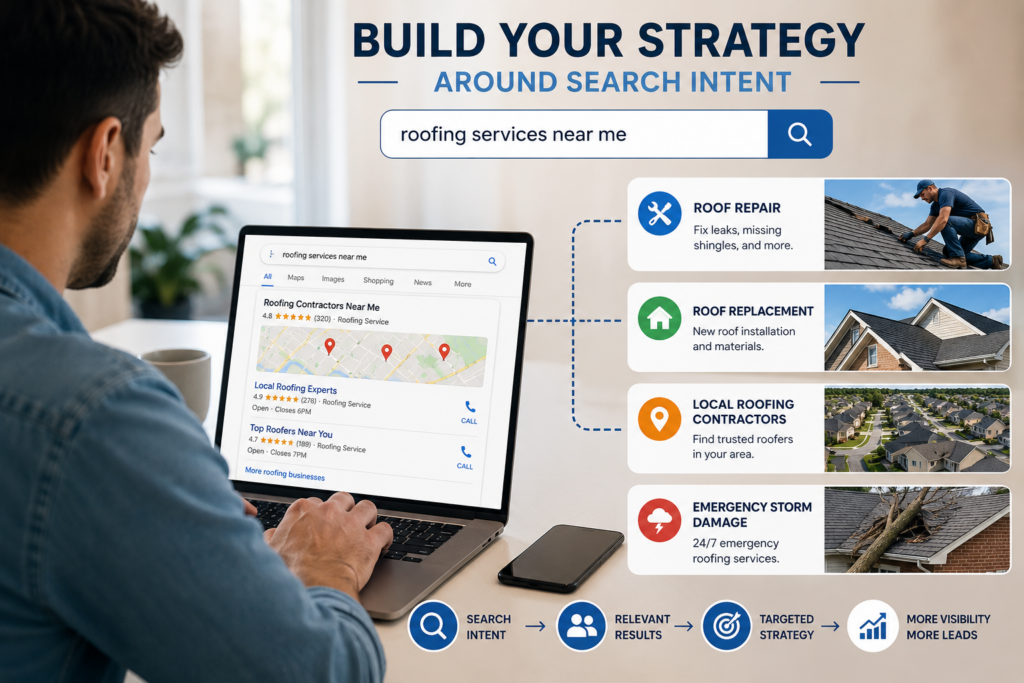
Build Your Strategy Around Search Intent
Before creating a page or blog post, consider what the searcher actually wants.
A homeowner searching for roofing services on a laptop or smartphone
Informational Intent
A homeowner might search:
“How do I know if my roof needs to be replaced?”
They need useful information before making a decision. An educational article can answer the question while introducing your expertise.
Commercial Intent
Someone searching for:
“Best roofing company for roof replacement”
is much closer to contacting a contractor.
Your service pages should provide clear information about your process, experience, services, project examples, and next steps.
Local Intent
A search such as:
“Roofing contractor in Dallas”
shows that location matters.
Your website and local presence should clearly communicate where you operate and which roofing services you provide in those areas.
Emergency Intent
Storms can create immediate roofing demand. Hail, wind, fallen trees, and severe leaks can cause homeowners to search for help quickly.
Creating useful storm-damage and emergency roofing resources allows you to address these urgent searches with relevant information and clear calls to action.
Target the Right Roofing Keywords
Keyword research remains an important part of SEO, but you should not focus exclusively on keywords with high search volume.
Instead, create groups based on your services and customer problems.
Core Roofing Services
Examples include:
Roof repair
Roof replacement
Roof installation
Roof inspection
Commercial roofing
Emergency roofing
Problem-Based Searches
You can also target searches related to specific problems:
Roof leak repair
Hail damage roof repair
Wind damage roof repair
Emergency roof repair
Damaged shingles
Location-Based Searches
If you serve multiple locations, consider relevant searches such as:
Roofing company in [city]
Roof repair in [city]
Roof replacement near [location]
Commercial roofing contractor in [city]
Long-Tail Questions
Longer searches can reveal valuable customer needs:
How much does roof replacement cost?
How long does a roof replacement take?
What should I do after hail damages my roof?
How can I tell whether my roof has storm damage?
A well-planned Roofing SEO Services strategy connects these keyword groups with the right pages instead of forcing every term onto one page.
Strengthen Your Local SEO Presence
Most roofing businesses depend heavily on customers within a defined service area. That makes local SEO an essential part of your strategy.
A roofing company service truck parked in a residential neighborhood,
Start by making your business information accurate and consistent.
Your local strategy can include:
An optimized Google Business Profile
Accurate business details
Consistent NAP information
Relevant local citations
Genuine customer reviews
Clearly defined service areas
Location-specific website content
Strong local landing pages
Your website should also make it easy for search engines and customers to understand where you operate.
However, avoid publishing dozens of thin location pages that simply replace one city name with another. Each location page should provide genuine value and explain why your services are relevant to customers in that market.
Optimize Your Roofing Website
Your website should clearly communicate what you offer and make it easy for visitors to take action.
Important roofing services should have dedicated pages covering:
What the service involves
Common problems
Signs that the service may be necessary
Your process
Relevant roofing materials
Frequently asked questions
Service locations
Trust signals
Contact options
You should also pay attention to technical fundamentals.
Make sure your website is:
Mobile-friendly
Easy to navigate
Fast and efficient
Secure
Clearly structured
Easy for search engines to understand
A technically sound website gives your content and service pages a stronger foundation.
Create Content That Builds Topical Authority
Publishing random roofing blogs is not the same as building topical authority.
A roofing professional reviewing different roofing topics
Instead, organize your content around major roofing services and customer concerns.
For example, if roof replacement is an important service, you could create supporting content about:
Signs you need a new roof
Roof replacement costs
How long different roofing materials last
Preparing for roof replacement
Roof replacement vs. roof repair
Common roof replacement mistakes
These articles can be connected through internal links and supported by your main roof replacement service page.
You can create similar content clusters around:
Roof repair
Storm damage
Emergency roofing
Commercial roofing
Roof inspections
Roofing materials
Roof maintenance
This gives your website greater topical depth while helping visitors find related information.
Make Your Content Useful for Conversational Search
Search behavior continues to evolve. Customers may use complete questions instead of short keyword phrases when looking for information.
For example, instead of searching only for:
“hail damage roofer”
a homeowner may ask:
“What should I do if a hailstorm damaged my roof?”
Your content should answer questions like these directly and clearly.
Use descriptive headings, concise explanations, useful examples, FAQs, and logical content structures.
You should also demonstrate genuine roofing expertise through:
Real project experiences
Original photographs
Inspection insights
Common roofing problems
Practical maintenance advice
Customer questions
Case studies
Clear service information
The goal is not to create content simply because a keyword exists. Your goal is to create information that genuinely helps your potential customers.
Build Trust Around Your Roofing Brand
Visibility is only part of the equation. Customers also need reasons to trust your company.
Your website can demonstrate credibility through:
Customer reviews
Testimonials
Project case studies
Before-and-after examples
Company information
Team experience
Clear service descriptions
Warranty information where applicable
Accurate contact details
You should also maintain consistent business information across important online platforms.
A specialized company such as The Roofers SEO can help roofing businesses approach SEO from an industry-specific perspective rather than applying a generic strategy designed for unrelated businesses.
Turn Search Traffic Into Roofing Leads
Getting visitors to your website is not enough. You need to make it easy for those visitors to become leads.
A homeowner visiting a roofing company website on a smartphone
Consider using:
Click-to-call buttons
Quote request forms
Service-specific CTAs
Emergency roofing CTAs
Contact forms
Customer testimonials
Trust signals near conversion areas
Your CTA should match the visitor’s intent.
For example, someone reading a general educational article might respond to:
“Need Help With Your Roof? Speak With a Roofing Professional.”
Someone visiting an emergency roofing page may respond better to:
“Request Emergency Roof Repair.”
Relevant CTAs can create a smoother transition from information to action.
Measure SEO Performance by Business Results
Do not judge your campaign only by keyword rankings.
Track metrics that show whether your strategy is contributing to business growth, including:
Organic traffic
Search impressions
Click-through rates
Local visibility
Google Business Profile interactions
Phone calls
Form submissions
Qualified leads
Conversion rates
Lead quality
A ranking can indicate visibility, but a qualified roofing lead has much greater business value.
Your SEO strategy should ultimately help you attract the right customers, not simply increase website traffic.
How Should You Choose a Roofing SEO Company?
You can handle some basic SEO tasks internally, but a comprehensive campaign requires knowledge across several areas.
Before choosing a provider, look for experience with:
Roofing businesses
Local SEO
Technical SEO
Content strategy
Search intent
Lead generation
Reputation management
Conversion optimization
Performance reporting
A Premier Roofing SEO Company should understand that your objective is not simply to collect rankings. Your strategy should connect visibility with qualified leads and measurable business outcomes.
Ask potential providers how they plan to improve your website, which pages they will prioritize, how they measure success, and how they will report meaningful results.
Build a Roofing SEO Strategy for Long-Term Growth
The strongest strategy is not based on one keyword, one blog post, or one optimization technique.
You need a connected system.
Start by identifying your highest-value services. Research the questions and problems your customers search for. Build useful service pages and supporting content. Strengthen your local presence. Demonstrate real expertise. Build trust through reviews and project evidence. Improve conversion paths, and measure the leads generated by your efforts.
Most importantly, keep improving your strategy as your market and search behavior change.
Ready to Generate More Roofing Leads From Search?
Your website should do more than provide information. It should help potential customers discover your services, understand your expertise, and take the next step.
If you want to build a strategy focused on local visibility, useful content, authority, and qualified roofing leads, explore our Roofing SEO Services.
Ready to discuss your goals and find the right strategy for your roofing business?
Contact The Roofers SEO today and start building a stronger search presence for your roofing company.
Frequently Asked Questions
What is roofing SEO?
Roofing SEO is the process of improving a roofing company’s website and online presence to attract relevant organic and local searches and turn that visibility into qualified leads.
How long does roofing SEO take to produce results?
Results vary depending on competition, website condition, location, content quality, authority, and the SEO strategy being implemented. Consistent optimization generally produces stronger long-term results than short-term tactics.
Is local SEO important for roofing companies?
Yes. Roofing services are location-dependent, so local SEO can help connect your business with homeowners and property owners searching for roofing services in the areas you serve.
Can roofing SEO generate more leads?
A well-planned strategy can attract people searching for specific roofing services and direct them toward service pages, calls, quote requests, and contact forms.
Does SEO help roofing companies with Google Maps visibility?
Local SEO can support your overall local presence by improving business information, website relevance, reviews, and other signals associated with local search visibility.
How can roofing companies improve their visibility in conversational search?
Create useful, original content that directly answers customer questions. Use clear headings, FAQs, relevant service information, local context, and evidence of genuine roofing expertise.
What should you look for in a roofing SEO company?
Look for roofing industry experience, transparent reporting, strong local SEO knowledge, quality content, technical expertise, measurable lead-generation objectives, and a strategy focused on your actual business goals.
When homeowners need roofing help, they often look for a contractor nearby. Searches such as “roofer near me,” “roof repair near me,” and “roofing contractor near me” show that the customer is actively looking for a local solution.
For your roofing business, appearing in these searches can create opportunities for phone calls, inspection requests, estimates, and new projects. However, local visibility does not happen simply because you mention your city on a website.
You need to make your business, services, locations, expertise, and customer value clear across your online presence. Combining local SEO, helpful content, AEO, GEO, reputation signals, and conversion optimization can help you build a stronger path from local search to qualified roofing leads.
What Do “Near Me” Searches Mean for Roofing Customers?
“Near me” searches generally indicate that someone wants a service provider within a convenient geographic area. For roofing companies, these searches can have strong commercial intent because the customer may already know what service they need.
Common searches include:
Roofer near me
Roofing contractor near me
Roof repair near me
Roof replacement near me
Emergency roofer near me
Hail damage roofing contractor near me
Commercial roofer near me
Each search can represent a different customer need. Someone searching for “roofing contractor near me” may be comparing companies, while someone searching for “emergency roofer near me” may need immediate assistance.
Your content and landing pages should therefore address different services and search intents instead of targeting every query with the same page.
Why Are “Near Me” Searches Valuable for Roofers?
Local roofing searches can be valuable because customers often want a contractor who can respond to their location and specific problem.
Consider a homeowner who notices water coming through a ceiling after a storm. They may not spend hours researching general roofing information. They are more likely to look for a roofing contractor nearby who can inspect the damage.
This creates opportunities to generate:
Phone calls
Inspection requests
Quote requests
Emergency repair leads
Roof replacement inquiries
Local website visits
Service-area customers
The objective is not simply to receive more traffic. You want your roofing business to become visible to people who are geographically relevant and have a genuine need for your services.
How Can Roofers Improve Their “Near Me” Visibility?
Improving local visibility requires several connected signals. Your business information, website, reviews, content, service areas, and local presence should all communicate a consistent message.
Optimize Your Google Business Profile
Your Google Business Profile should accurately represent your roofing company.
Make sure your business information, primary category, services, phone number, website, hours, photos, and other relevant details are accurate.
Add genuine photos of completed roofing projects, your team, equipment, and business activities. Keep the profile current and respond professionally to customer reviews.
Your profile should answer basic questions quickly:
Who are you? What roofing services do you provide? Where do you work? How can a customer contact you?
The clearer the information, the easier it is for potential customers to evaluate your business.
Keep NAP Information Consistent
NAP means Name, Address, and Phone number.
Your business details should remain consistent across your website, relevant directories, local profiles, and other important online references.
For example, avoid using different versions of your company name or phone number across different platforms unless there is a legitimate reason.
Consistent business information strengthens the connection between your company, its identity, and its location.
Build Location-Specific Roofing Pages
If you serve multiple cities or communities, create useful location-specific pages for the areas you actually serve.
For example:
Roof Repair in [City]
Roof Replacement in [City]
Emergency Roofing in [City]
Commercial Roofing in [City]
However, avoid creating dozens of nearly identical pages where only the city name changes.
Instead, make each page genuinely useful. Include relevant local roofing concerns, services available in that area, property types, weather considerations, customer questions, and clear contact information.
This gives customers useful information while strengthening geographic context around your business.
How Does Google Maps Visibility Help Generate Roofing Leads?
When someone searches for a roofing company nearby, map-based results can become an important discovery point.
How Does Google Maps Visibility Help Generate Roofing Leads
A customer may compare several businesses based on their location, reviews, services, business information, website, and overall presentation.
Your objective should therefore be more than simply appearing on a map. Your local profile should give a potential customer enough information to take the next step.
A strong local presence can encourage customers to:
Call your business
Visit your website
Request an estimate
Compare your services
Learn about your reputation
Make sure the experience remains consistent after the customer leaves the map listing and visits your website.
How Can Roofers Use Local Content to Capture More Searches?
Local content can help you address questions that customers in your service areas actually ask.
Instead of publishing only broad topics such as “How to Maintain Your Roof,” create content around specific local needs.
For example:
What Roofing Problems Are Common in [City]?
How Does Severe Weather Affect Roofs in [City]?
When Should You Replace a Roof in [City]?
What Should You Do After Hail Damages Your Roof?
How Can You Prepare Your Roof for Storm Season?
This approach can strengthen topical authority while giving customers useful information.
You should also avoid creating content solely because a keyword has a location attached to it. Local content works better when it provides genuine value and reflects the services, problems, and conditions relevant to your market.
How Does AEO Help Roofers Capture “Near Me” Questions?
Answer Engine Optimization, or AEO, focuses on making information easy to understand when users ask direct questions.
For roofing companies, this means answering important questions clearly instead of hiding the answer under a long introduction.
For example:
How can a roofer improve local search visibility?
A direct answer could explain that a roofer should maintain accurate business information, optimize its local profile, publish useful service-area content, build genuine reviews, and make its website easy to understand.
You can then expand on each recommendation.
Use question-based headings, concise explanations, bullet points, FAQs, and clear definitions throughout your content.
This format can improve usability while making important information easier for search systems to interpret.
How Does GEO Help Roofing Businesses Become More Relevant in AI Search?
Generative Engine Optimization, or GEO, focuses on creating clear relationships between your business, services, locations, and expertise so that your content can be better understood in generative search experiences.
Learn how GEO helps roofing businesses connect services, locations, customer problems, and solutions to improve visibility in AI search.
For a roofing company, geographic context is especially important.
For example, if you provide roof replacement in a particular city, your website should clearly explain the service, locations served, types of properties you work on, and problems you help solve.
You should also maintain consistent information about your company across relevant online sources.
GEO is not about stuffing content with location names. It is about providing meaningful context that makes your business easier to understand.
How Can AI Search Understand Your Roofing Business Better?
Clear and structured information can make your website easier for both people and automated systems to interpret.
Your website should clearly communicate:
Business name
Roofing services
Service areas
Contact information
Areas of expertise
Customer questions
Relevant project information
Local business context
Use descriptive headings and natural language.
For example, a storm-damage page should explain the types of damage customers may experience, inspection considerations, emergency repair options, replacement considerations, and the areas where you provide the service.
This creates stronger relationships between your services, expertise, locations, and customer needs than repeatedly inserting phrases such as “roofer near me.”
What Role Do Roofing SEO Services Play in “Near Me” Lead Generation?
Local visibility requires more than one optimization tactic. Professional roofing SEO services for local lead generation can combine local SEO, content strategy, technical optimization, AEO, GEO, reputation signals, and conversion optimization.
A comprehensive strategy can include:
Local keyword research
Google Business Profile optimization
Location-page development
On-page SEO
Technical SEO
Local content creation
Internal linking
Reputation management
AEO-focused content
GEO-focused optimization
Conversion optimization
The goal should not be to generate impressions alone.
The more important objective is to create a clear path from local search visibility to meaningful customer action.
Why Should You Choose a Premier Roofing SEO Company?
Roofing customers do not all have the same needs.
A homeowner looking for emergency roof repair has a different search intent from a commercial property owner researching a complete roof replacement.
A Premier Roofing SEO Company can build a strategy around different roofing services, customer questions, locations, and search intents.
A specialized roofing approach can also help connect your website content with seasonal demand, storm-related searches, local service needs, and high-value roofing projects.
Instead of treating your website like a generic local business website, the strategy should reflect how roofing customers actually search and make purchasing decisions.
How Can You Turn “Near Me” Visibility Into Actual Roofing Leads?
Getting discovered is only the first step.
Your lead-generation process should look like this:
Near-Me Search → Local Visibility → Maps/Website → Trust → Contact → Roofing Lead
Once a potential customer reaches your website, make the next step obvious.
Use:
A visible phone number
Click-to-call functionality
Simple quote forms
Service-specific landing pages
Customer reviews
Project information
Trust signals
Mobile-friendly design
Clear calls to action
A customer should not have to search through several pages to figure out how to request help.
Your website should move visitors naturally from information to action.
Frequently Asked Questions About “Near Me” Roofing Searches
How can roofers rank for “near me” searches?
Roofers can improve local visibility by maintaining accurate business information, optimizing their Google Business Profile, creating useful location-specific content, earning genuine reviews, and developing strong local relevance across their website and online presence.
Does Google Business Profile help roofing companies get local leads?
A well-maintained Google Business Profile can help potential customers discover and evaluate your roofing company through local search and map-based experiences. Accurate services, contact details, photos, reviews, and business information make the profile more useful.
How important are reviews for roofing “near me” searches?
Genuine customer reviews can influence how potential customers evaluate nearby roofing companies. Recent and service-relevant feedback can strengthen trust and help prospects understand the experience they may receive before contacting your business.
Can location pages help roofers attract nearby customers?
Useful location pages can help explain which communities you serve and which roofing services you provide. Each page should contain meaningful local information instead of simply replacing a city name in duplicated content.
How can Roofing SEO Services improve local roofing leads?
Roofing SEO Services can combine local SEO, content, technical optimization, AEO, GEO, reputation strategy, and conversion optimization to improve local visibility and create a clearer path from search discovery to customer contact.
Get More Roofing Leads From Local “Near Me” Searches
Your potential customers are already searching for roofing services in their area. The challenge is making your business easy to find, understand, trust, and contact when those searches happen.
A strong local strategy connects your services with the locations you serve, answers customer questions, strengthens your reputation, and creates a simple path from local search to contact.
If you want to turn local search visibility into more qualified roofing opportunities, The Roofers SEO can help you build a strategy focused on local SEO, AEO, GEO, AI search visibility, and lead generation.
A hailstorm can create an immediate surge in demand for roof inspections, repairs, and replacements. Homeowners who notice dents, cracked shingles, leaks, or other signs of damage often start searching for a roofing contractor quickly. For you as a roofer, this creates a valuable opportunity to use Roofing SEO Services to turn urgent search demand into qualified phone calls.
However, being available after a storm does not automatically mean homeowners will find you. You need the right combination of local visibility, helpful content, strong service pages, trust signals, and conversion-focused website elements.
Here is how you can prepare your roofing business to capture more calls after a hailstorm.
Why Do Hailstorms Create a Sudden Spike in Roofing Searches?
After a severe hailstorm, homeowners want answers quickly. They may search for a roof inspection, emergency repair, or a local contractor who can determine whether their roof has suffered damage.
These searches often have strong commercial intent because the person is already looking for a solution.
For example, homeowners may search for:
Hail damage roof repair
Hail damage roof inspection
Roofers near me after hailstorm
Emergency roof repair
Hail damage roofing contractor
If your website and local business presence are optimized around these needs, you have a better opportunity to appear when potential customers are ready to contact a roofer.
Target High-Intent Hail Damage Keywords Before the Storm Happens
One mistake you should avoid is waiting until a hailstorm happens before creating your SEO strategy. Search visibility takes time to build, so your storm-related pages should already exist before demand increases.
Start by creating keyword groups around different customer intents.
Inspection keywords can target homeowners who are unsure whether their roof has been damaged.
Repair keywords can reach people who already know they need roofing work.
Emergency keywords can capture homeowners dealing with leaks or serious damage.
You should also combine services with locations. For example, instead of targeting only “hail damage roof repair,” you can build content around phrases such as “hail damage roof repair in [city]” or “hail damage roof inspection near [service area].”
This approach helps you connect your services with the people most likely to need them.
Your general roofing service page may not fully address the concerns of someone searching immediately after a hailstorm.
A dedicated hail damage landing page gives you an opportunity to explain exactly what you offer.
Your page should clearly describe:
Hail damage inspection services
Common signs of roof damage
Emergency repair options
Areas you serve
Roofing materials you repair
Your inspection process
Customer reviews
Real project photos
Clear contact information
Most importantly, make it easy for visitors to call you.
Use prominent hail damage roof inspection and emergency roof repair calls to action throughout the page without making the content feel overly promotional.
Strengthen Your Google Maps Visibility After a Hailstorm
When homeowners need a roofer quickly, local search visibility becomes especially important. They may search for nearby contractors and compare businesses based on location, reviews, services, and overall credibility.
Your Google Business Profile should accurately represent your roofing company and the services you provide.
Keep your business information consistent and make sure your profile includes relevant roofing services. Add high-quality project photos and continue collecting genuine customer reviews.
You can also publish timely updates when appropriate to inform customers about your available services, inspection process, or storm-related roofing assistance.
The goal is to make it immediately clear that your business can help with the problem the customer is searching for.
Publish Hailstorm Content While Search Demand Is High
Timing matters after a major storm.
Instead of publishing only general roofing articles, create useful content that answers the questions homeowners are asking right now.
For example, you could publish articles such as:
Signs Your Roof Has Hail Damage
What to Do After a Hailstorm Damages Your Roof
How Much Does Hail Damage Roof Repair Cost?
When Should You Schedule a Roof Inspection After Hail?
Does Hail Damage Require a Full Roof Replacement?
This content can support your main service pages while giving potential customers useful information before they make a decision.
You should also make your content location-specific when appropriate. A storm-related article that discusses your local service area can be more useful to nearby homeowners than a completely generic article.
Use Hail Damage FAQs to Capture More Search Intent
Homeowners often have many questions before calling a roofing contractor.
You can turn those questions into useful FAQ content.
For example:
Do I need a roof inspection after hail?
You may need an inspection even when damage is not obvious. A professional inspection can help identify visible and less obvious signs of hail impact.
How soon should hail damage be repaired?
You should address suspected damage as soon as reasonably possible, particularly if there are signs of leaks or exposed roofing materials.
Can small hail damage cause roof problems?
Yes. Depending on the roofing material and severity of the storm, seemingly minor impact can contribute to roofing problems over time.
Should I contact a roofer after a major hailstorm?
If you suspect damage, arranging a professional inspection can help you understand the condition of your roof and determine what work may be necessary.
FAQ content can also strengthen your service pages by addressing customer concerns before they become objections.
Show Real Roofing Work to Build Trust Quickly
After a hailstorm, homeowners may receive offers from multiple roofing contractors. Trust can therefore become a major factor in their decision.
Real project evidence can help.
Show before-and-after photographs, completed roofing projects, inspection examples, and customer experiences where appropriate.
You can also create project-focused content that explains:
Where the project was completed
What type of damage was discovered
Which roofing material was involved
What work was completed
How the problem was addressed
This gives prospective customers something concrete to evaluate instead of relying only on promotional claims.
Make Your Website Ready to Convert Hailstorm Traffic Into Calls
Getting visitors to your website is only one part of the process. You also need to make contacting you easy.
Your website should work smoothly on mobile devices because many homeowners will search for a roofing contractor from their phones.
Make sure your phone number is easy to find and use clickable call buttons where appropriate.
Your landing pages should also load quickly and avoid unnecessary distractions.
Strong calls to action can include:
Schedule a Hail Damage Roof Inspection
Call for Emergency Roof Repair
Request a Roof Damage Assessment
Get Your Roof Inspected Today
Keep your forms simple as well. A homeowner dealing with storm damage should not have to complete a long questionnaire before requesting assistance.
Use Reviews and Reputation to Win Hail Damage Leads
A homeowner may compare several roofing companies before making a call. Your online reputation can influence which contractor gets that call.
Encourage satisfied customers to leave genuine reviews about their experiences.
Recent reviews can help demonstrate that your company is actively serving customers. Reviews that naturally discuss professionalism, communication, inspections, repairs, and completed roofing work can also give potential customers more useful information.
Do not rely on reviews alone, though. Combine them with project photos, detailed service pages, local information, and clear contact options to create stronger trust.
Track Which Hailstorm Strategies Are Generating Calls
You should not judge your storm SEO strategy only by rankings or website traffic.
The more important question is whether your visibility is generating qualified roofing opportunities.
Track metrics such as:
Phone calls
Inspection requests
Quote requests
Organic traffic
Landing page conversions
Google Business Profile actions
Qualified leads
Booked roofing jobs
This information helps you identify which pages and strategies are actually contributing to business growth.
If one hail damage page generates significantly more inspection requests than another, you can study what makes it effective and apply those lessons elsewhere.
Prepare Your Roofing Website Before the Next Hailstorm
The best time to build your storm SEO foundation is before the storm arrives.
Create your hail damage pages in advance. Optimize your local presence. Build relevant content. Collect customer reviews. Improve website performance and make your contact process simple.
Then, when a major storm creates new search demand, you are not starting from zero.
You already have pages, content, local signals, and conversion paths that can help you compete for attention.
Preparation also gives you time to improve your strategy based on previous storm seasons.
How Roofing SEO Services Can Help You Capture Post-Hailstorm Leads
A strong storm lead strategy requires more than publishing one article after a hailstorm.
Professional Roofing SEO Services can bring together keyword research, local SEO, service-page optimization, content development, technical improvements, conversion optimization, and performance tracking.
The objective is to build a search presence that connects your roofing services with homeowners who are actively looking for help.
As a Premier Roofing SEO Company, your SEO partner should understand that roofing search behavior can change quickly after severe weather. Your strategy should therefore focus on both long-term visibility and opportunities created by seasonal or emergency demand.
The right approach can help you build a stronger digital foundation before storm season and respond more effectively when demand increases.
Final Takeaway: Turn Hailstorm Search Demand Into Roofing Calls
A hailstorm can create a short window of intense demand for roofing services. To take advantage of it, you need to be visible when homeowners search, provide answers to their immediate questions, demonstrate that they can trust your company, and make contacting you effortless.
Build your hail damage landing pages before storms happen. Target high-intent local keywords. Strengthen your Google Maps presence. Publish useful storm-related content. Show real roofing work. Build your reputation and track the calls and leads your strategy generates.
When you prepare before the storm instead of reacting afterward, you give your roofing business a much stronger opportunity to turn hail damage searches into inspections, calls, and qualified roofing leads.
Need to improve your roofing business’s visibility and generate more qualified leads? Contact The Roofers SEO to discuss a search strategy built around your roofing services and target market.
Frequently Asked Questions
How can roofers get more leads after a hailstorm?
Focus on local search visibility, hail damage service pages, Google Maps optimization, useful storm-related content, reviews, and clear call-to-action elements that make it easy for homeowners to request an inspection.
What keywords should roofers target after hail damage?
Target high-intent phrases related to hail damage roof repair, roof inspection, emergency roofing, local roofing contractors, and location-specific hail damage services.
How important is Google Maps for post-hailstorm roofing leads?
It can be highly valuable because homeowners often look for nearby roofing contractors when they need an inspection or repair quickly. Accurate business information, services, photos, and genuine reviews can strengthen your local presence.
Should roofers create a dedicated hail damage landing page?
Yes. A dedicated page allows you to address hail-specific concerns, target relevant search terms, explain your services, show proof of your work, and provide direct options for contacting your company.
How quickly should roofers publish hailstorm-related content?
You should prepare foundational content before storm season. After a significant storm, update or publish relevant local content quickly while customer demand and search activity are increasing.
When homeowners notice a roof leak, missing shingles, storm damage, or signs of an aging roof, they rarely contact the first roofing company they find. Most begin by searching for information. They want to understand the problem, explore their options, estimate potential costs, and find a contractor they can trust.
This creates a valuable opportunity for roofing companies.
Instead of waiting until a homeowner searches specifically for a roofer, you can become the trusted source they turn to when they have roofing questions.
By combining helpful content, strong local visibility, clear service information, customer proof, and strategic Roofing SEO Services, you can position your business as a reliable answer throughout the homeowner’s decision-making journey.
What Does It Mean to Be the Go-To Answer for Homeowners?
Being the go-to roofing company means more than ranking for a handful of popular keywords.
It means becoming a recognizable and trustworthy source when homeowners need information about their roofs.
A homeowner might search:
Why is my roof leaking?
How long do asphalt shingles last?
Should I repair or replace my roof?
How much does a roof replacement cost?
What should I do after a hailstorm?
How can I identify storm damage?
How often should my roof be inspected?
Which roofing material is right for my home?
If your website consistently provides useful answers to these questions, homeowners are more likely to recognize your business as knowledgeable and trustworthy.
The goal is simple: answer the question, demonstrate your expertise, and provide a clear next step.
Understand the Questions Homeowners Ask Before Hiring a Roofer
Before creating content, you need to understand what your potential customers actually want to know.
Homeowners do not always begin with commercial searches such as “roofing contractor near me.” Their journey often starts with a problem.
For example, someone who notices water stains on their ceiling may first search for possible causes before searching for a roofing contractor.
Your content should therefore address different stages of search intent.
Problem-Based Questions
These questions address problems homeowners are experiencing.
Examples include:
Why is my roof leaking?
Why are my shingles curling?
What causes roof discoloration?
Why is my attic getting wet?
What does missing roofing granules mean?
Research-Based Questions
These help homeowners understand possible solutions.
Examples include:
Should I repair or replace my roof?
Which roofing material lasts the longest?
How often should a roof be replaced?
What happens during a roof inspection?
How long does a roof replacement take?
Hiring-Based Questions
These questions usually appear when a homeowner is closer to contacting a contractor.
Examples include:
How do I choose a roofing contractor?
What should a roofing estimate include?
What questions should I ask a roofer?
How can I evaluate a roofing company?
What should I look for in a roofing contract?
By creating content for each stage, your company can remain visible throughout the customer’s decision-making process.
Create Helpful Content That Answers Real Roofing Questions
Your website should do more than list your roofing services.
It should educate homeowners.
Create useful articles, FAQs, service guides, checklists, project resources, and educational pages that directly address common roofing concerns.
For example, instead of publishing a generic article about roof repair, you could create resources such as:
How to Tell If Your Roof Needs Repair or Replacement
What to Do When You Discover a Roof Leak
How to Prepare for a Professional Roof Inspection
What Homeowners Should Know About Hail Damage
How Long Different Roofing Materials Typically Last
What Causes Roof Leaks During Heavy Rain
Keep these resources practical.
Explain what homeowners should look for, what a problem could indicate, and when professional assistance may be appropriate.
Answer Important Questions Early
When homeowners ask a question, they should not have to read an entire article before finding the answer.
Start important sections with a concise explanation, then provide supporting details.
For example:
Can a small roof leak become a major problem?
Yes. Even a small leak can allow moisture to enter roofing materials, insulation, ceilings, or other areas of a property. Addressing the source early can help prevent more extensive damage.
You can then explain the warning signs, potential causes, and recommended next steps.
This structure makes your content easier to understand and more useful for answer-focused searches.
Build Local Authority Around Your Roofing Services
Roofing is a highly local industry.
A homeowner generally needs a contractor who serves their city, neighborhood, or surrounding communities.
That makes local authority extremely important.
Your website should clearly communicate:
The areas you serve
Your roofing services
Local project experience
Types of properties you work on
Common weather-related roofing concerns
Customer experiences
Business contact information
You can also create useful location-focused content around roofing issues relevant to your service area.
However, avoid creating dozens of nearly identical location pages where only the city name changes.
Instead, make location pages genuinely useful by providing relevant information, local project examples, service details, and answers to common questions.
This gives homeowners a stronger reason to view your company as a legitimate local roofing resource.
Use Service-Specific Content to Match Homeowner Intent
Every important roofing service should have content that addresses the questions homeowners have about that service.
For example, a roof replacement page can explain:
When replacement may be necessary
Available roofing materials
The replacement process
Factors that influence project costs
Typical project timelines
What homeowners should prepare for
Why professional installation matters
A storm damage roofing page can explain what homeowners should do after severe weather, which signs may indicate damage, and why a professional inspection may be useful.
Likewise, a roof repair page can explain common repair situations, warning signs, and what homeowners should consider before choosing a solution.
This service-specific approach makes your website more informative and helps visitors understand exactly how your company can help.
Strengthen Your Roofing Website’s Expertise and Trust
Roofing is a significant investment.
Homeowners want confidence before allowing a contractor to work on their property.
Your website should therefore demonstrate expertise through useful information and real evidence.
Consider including:
Experienced team information
Relevant licenses or certifications
Insurance information where appropriate
Genuine customer reviews
Before-and-after project examples
Case studies
Project photographs
Detailed service explanations
Frequently asked questions
Clear business information
Your content should also be accurate and transparent.
Avoid relying entirely on broad claims such as “the best roofing company.” Instead, demonstrate your expertise through specific information, real projects, customer experiences, and helpful explanations.
The more evidence you provide, the easier it becomes for homeowners to evaluate your company.
Optimize Content for Answer-Based Search
Homeowners increasingly search using complete questions and conversational phrases.
Your website should reflect the way people naturally ask questions.
Instead of creating a page focused only on:
Roof repair
you can build content around questions such as:
When should you repair a roof instead of replacing it?
Then provide a clear answer followed by supporting information.
Use:
Question-based headings
Clear answers
Short paragraphs
Bullet points
Descriptive subheadings
Simple explanations
Relevant examples
Useful FAQs
This makes your content easier for homeowners to scan and understand.
It also creates a stronger foundation for Answer Engine Optimization (AEO) because your content is organized around direct questions and useful answers.
Your objective should not simply be to attract visitors. It should be to provide information that genuinely solves their problems.
Show Proof Through Reviews, Projects, and Case Studies
Educational content can demonstrate knowledge, but proof can strengthen trust.
Add genuine customer reviews and project examples to your website.
Case studies can be especially useful because they show homeowners how your team handles real roofing situations.
A simple case study might explain:
The Problem: A homeowner was experiencing recurring leaks from an aging roof.
The Inspection: The roofing team evaluated the roof and identified the likely source of the problem.
The Solution: The contractor discussed the available options and completed the appropriate roofing work.
The Result: The homeowner received a roofing solution suited to the property’s needs.
This type of content gives potential customers a better understanding of your process.
Instead of simply saying that you provide quality roofing, you demonstrate what your work looks like.
Keep Your Business Information Consistent Across Local Platforms
Your business information should be accurate wherever homeowners may discover your company.
Keep important information such as your:
Business name
Address
Phone number
Website
Service areas
Business hours
Roofing services
consistent across relevant business directories and local profiles.
Inconsistent information can create confusion and may reduce a potential customer’s confidence in your business.
Your local visibility strategy should therefore include maintaining accurate and professional business information across the platforms that matter to your customers.
Turn Roofing FAQs Into Lead-Generating Content
Frequently asked questions should not be treated as an afterthought.
They can become valuable content opportunities.
For example, instead of simply adding:
“How do I know if hail damaged my roof?”
to the bottom of a service page, create a helpful explanation covering common signs such as damaged shingles, exposed areas, dents, granule loss, or other visible concerns.
Then provide an appropriate next step.
For example:
Not sure whether your roof has storm damage? A professional roofing evaluation can help determine whether further attention is needed.
This creates a natural progression:
Question → Information → Trust → Action
That is exactly what effective roofing content should accomplish.
Connect Educational Content With Your Service Pages
Your blog should not operate separately from the rest of your website.
Connect relevant educational articles to appropriate service pages using natural internal links.
For example:
A blog about roof leak warning signs can link to your roof repair service.
A guide about hail damage can connect to your storm damage roofing service.
An article about roof lifespan can connect to your roof replacement service.
This creates a logical journey for visitors.
Someone who arrives on your website looking for an answer can easily move from educational information to the appropriate service when they are ready.
Use Roofing SEO Services to Build Long-Term Search Visibility
Becoming the go-to answer does not happen by publishing a few blog posts.
Your website needs a consistent strategy connecting:
Keyword research
Search intent
Content creation
On-page SEO
Technical SEO
Internal linking
Local SEO
Service pages
Conversion optimization
Reputation signals
Content updates
Professional Roofing SEO Services can help you identify the questions homeowners are searching for, organize your website around relevant topics, improve existing pages, strengthen local visibility, and develop a sustainable search strategy.
For example, your content strategy can create connected topic clusters around:
Instead of publishing unrelated articles, you create a useful information ecosystem.
That can help your website become a stronger resource for homeowners researching roofing problems and solutions.
How The Roofers SEO Helps Roofers Become the Go-To Answer
Becoming the go-to answer requires more than chasing rankings.
Your website needs to communicate expertise, answer homeowner questions, establish local relevance, and make it easy for visitors to take action.
The Roofers SEO focuses on roofing-specific search strategies designed around how homeowners discover, research, and evaluate roofing businesses.
From content strategy and on-page optimization to local visibility and conversion-focused improvements, a specialized approach can help your roofing website become a stronger resource for potential customers.
As a Premier Roofing SEO Company, The Roofers SEO understands that roofing businesses need more than website traffic. Your visibility should support meaningful inquiries, qualified leads, and sustainable business growth.
If your website is not answering the questions your potential customers are asking, you may be losing opportunities before those homeowners ever reach your service pages.
Make It Easy for Homeowners to Take the Next Step
Helpful information should eventually give homeowners a clear path forward.
Your calls to action should feel natural rather than interrupting the educational experience.
For example, after explaining how homeowners can identify potential roof problems, you can encourage them to seek professional assistance when appropriate.
Use descriptive CTAs such as:
Get Professional Roofing SEO Services for Your Business
or:
Talk to a Roofing SEO Specialist About Growing Your Online Visibility
The CTA should match the visitor’s intent.
Someone reading an educational article may need more information, while someone visiting a service page may be ready to contact your business.
Ready to Grow Your Roofing Business?
Your next customer may begin with a simple roofing question.
Make sure your business is there with a useful answer.
If you want to turn more roofing searches into qualified opportunities, connect with a team that understands the unique search behavior of roofing customers. A specialized SEO strategy can help improve your online visibility, strengthen your website, and create a clearer path from search to lead.
Conclusion: Become the Roofer Homeowners Trust First
Homeowners do not always begin their roofing journey by searching for a contractor.
They often begin with a question.
The roofing companies that consistently answer those questions with useful, accurate, and locally relevant information have an opportunity to become trusted resources before competitors even enter the conversation.
Build content around real homeowner problems. Explain your services clearly. Demonstrate expertise with genuine project evidence. Strengthen your local presence. Optimize your website for questions and answers. Most importantly, make every important page useful to the person reading it.
With a strategic SEO and content approach, your roofing company can move beyond simply being another contractor in search results.
You can work toward becoming the go-to answer homeowners remember when they need roofing help.
Frequently Asked Questions
1. How can a roofing company become the go-to answer for homeowners?
Create helpful content that answers real roofing questions, build local authority, demonstrate expertise through projects and reviews, and make it easy for homeowners to contact your company when they need professional assistance.
2. What type of content should roofing companies publish?
Roofing companies should publish answers to common homeowner questions, service guides, maintenance advice, storm damage resources, repair and replacement information, FAQs, case studies, and locally relevant roofing content.
3. Why are roofing FAQs important for SEO?
FAQs help address specific questions homeowners search for and allow your website to provide concise, useful answers. They can also support broader topic coverage and improve the usefulness of service and informational pages.
4. How does local SEO help roofers attract homeowners?
Local SEO helps roofing companies improve visibility when homeowners search for roofing services in their service areas. Accurate business information, local relevance, useful content, reviews, and strong local signals can support better visibility.
5. Can Roofing SEO Services help my company become a trusted roofing resource?
Yes. A specialized strategy can connect keyword research, content development, technical optimization, local SEO, service pages, and conversion improvements to help your website become more useful and visible to homeowners.
The roofing industry has always depended on visibility. When homeowners or businesses need roof repairs, replacements, inspections, or emergency services, they usually begin their search online. However, the way customers search for roofing services is changing rapidly.
In the past, roofing companies focused mainly on ranking for specific keywords such as “roof repair near me” or “roof replacement contractor.” While traditional SEO remains important, search behavior is becoming more conversational and question-focused. Customers are no longer searching only for company names or short keywords. They are asking detailed questions and expecting direct, reliable answers.
For example, instead of searching only “roof replacement contractor,” a customer may ask:
“How much does a roof replacement cost?”
“How do I know if my roof needs replacement?”
“What is the best roofing material for my home?”
“How long does a commercial roof last?”
This shift has created the need for Answer Engine Optimization (AEO), a strategy focused on helping your website provide clear answers to customer questions.
AEO is becoming an essential part of a successful Roofing SEO Service because modern search experiences prioritize useful information, expertise, and direct solutions. Roofing businesses that create content designed to answer real customer concerns have a better opportunity to build trust, improve visibility, and attract qualified leads.
At The Roofers SEO, the focus is on helping roofing companies adapt to the future of search by combining proven SEO strategies with advanced optimization methods. By preparing your website for answer-driven searches, you can create a stronger digital presence and connect with customers earlier in their decision-making process.
What Is Answer Engine Optimization (AEO)?
Answer Engine Optimization (AEO) is the process of optimizing your website content so search systems can easily understand, identify, and present your answers to user questions.
For roofing companies, this means creating content that does more than mention roofing services.
Traditional SEO focuses on improving rankings for keywords and search terms. AEO focuses on providing direct answers that match user intent.
For roofing companies, this means creating content that does more than mention roofing services. Your website should answer the questions potential customers are already asking before they contact a contractor.
For example, a traditional SEO page might target:
“Roof replacement services in Dallas”
An AEO-focused approach would also answer questions like:
“How much does roof replacement cost in Dallas?”
“How long does a roof replacement take?”
“What factors affect roofing prices?”
“How can I choose the right roofing contractor?”
By answering these questions clearly, you help customers find valuable information while showing expertise in your industry.
How AEO Differs From Traditional SEO
SEO and AEO work together, but they have different goals.
Traditional SEO focuses on:
Keyword optimization
Website rankings
Backlinks
Technical performance
Organic traffic growth
AEO focuses on:
Answering customer questions
Understanding search intent
Creating helpful content
Improving information accuracy
Providing quick solutions
AEO does not replace SEO. Instead, it strengthens your overall Roofing SEO Service strategy by making your website more useful for both search engines and customers.
A roofing website that combines SEO fundamentals with AEO principles has a better chance of reaching users throughout different stages of the buying journey.
How Answer-Focused Search Experiences Work
Customers want quick and accurate information. When someone searches for roofing advice, they are often looking for immediate guidance before making a final decision.
For example, a homeowner noticing water stains on their ceiling may search:
“What are signs I need a new roof?”
They are not ready to call a roofing company immediately. First, they want information. They want to understand the problem, possible solutions, and whether they need professional help.
A roofing business that publishes a detailed article explaining roof damage signs, repair options, and when replacement is necessary can build trust before the customer contacts any contractor.
This is where AEO creates value.
By creating content that directly answers customer questions, you can:
Increase brand visibility
Establish industry authority
Educate potential customers
Improve engagement
Generate more qualified roofing leads
Search is moving toward helpful answers, and roofing businesses need to adjust their content strategies accordingly.
Why Does AEO Matter for Roofing SEO Service Success?
The success of a roofing business online depends on reaching customers at the right moment. AEO helps you become visible when customers are actively looking for solutions.
More Question-Based Searches
People are becoming more specific with their searches. Instead of entering simple keywords, they ask complete questions.
Examples include:
“How often should I replace my roof?”
“Can a damaged roof be repaired?”
“What is the average lifespan of asphalt shingles?”
“How much does commercial roofing cost?”
These searches show strong customer intent. Someone asking these questions is often closer to needing professional roofing services.
By creating content that answers these searches, you can attract visitors who are more likely to become leads.
Customers Want Immediate Solutions
Roofing problems often require quick decisions. A leaking roof, storm damage, or structural concern can create urgency.
Customers do not want complicated information. They want clear answers from businesses they can trust.
AEO helps your website provide:
Simple explanations
Helpful recommendations
Professional insights
Clear next steps
When your website answers customer questions effectively, you create a better experience before the first phone call.
Competition Among Roofing Companies Is Increasing
The roofing industry has become highly competitive online. Many roofing companies now invest in websites, advertising, and SEO strategies.
Ranking for basic roofing keywords is becoming more challenging because many businesses are targeting similar terms.
AEO allows you to stand out by creating deeper, more valuable content.
Instead of only competing for keywords, you compete by becoming a trusted source of roofing information.
A roofing company that explains complex topics clearly can build stronger credibility than competitors who only publish promotional content.
Trust and Expertise Are More Important Than Ever
Roofing is a high-value service. Customers are not making small purchases. They are trusting contractors with one of the most important parts of their property.
Before contacting a roofing company, customers often research:
Roofing materials
Repair options
Cost factors
Contractor selection tips
Maintenance requirements
Your website content should demonstrate real expertise.
This is why working with experienced Roofing SEO Experts can help you create content strategies that showcase your knowledge while improving online visibility.
How AEO Works With Traditional Roofing SEO Strategies
A common misconception is that AEO will replace traditional SEO. However, the future of search optimization is not about choosing between SEO and AEO. Successful roofing businesses will combine both strategies to create a stronger online presence.
Your traditional Roofing SEO Service foundation still matters. Search engines need to understand your website, services, location, and expertise. At the same time, your content needs to provide direct answers that match what customers are searching for.
AEO strengthens your existing SEO efforts by making your website more helpful, relevant, and customer-focused.
Here is how AEO works alongside traditional SEO strategies:
Keyword Research Becomes More Customer-Focused
Keyword research has always been an important part of SEO. However, modern keyword strategies need to go beyond finding popular search terms.
Instead of only targeting:
“roof repair services”
“roofing contractor”
“roof replacement company”
You should also identify customer questions such as:
“How much does roof repair cost?”
“How do I find a reliable roofing contractor?”
“What should I do after storm roof damage?”
“How long does a roof inspection take?”
These question-based searches reveal customer concerns and buying intentions.
By understanding what your audience wants to know, you can create content that attracts visitors who are actively looking for roofing solutions.
Helpful Content Creation Supports Both SEO and AEO
Content remains one of the strongest elements of online visibility. However, creating content only for search engines is no longer enough.
Your content should be written for real customers.
A successful roofing content strategy should include:
Educational blog posts
Detailed service pages
Frequently asked questions
Project explanations
Roofing guides
Maintenance tips
Local roofing information
For example, instead of creating a short page about roof replacement, you can create a complete resource explaining:
Signs your roof needs replacement
Average replacement timeline
Material options
Cost considerations
Benefits of professional installation
This approach improves user experience while supporting stronger search visibility.
Website Structure Helps Search Systems Understand Your Business
A well-organized website makes it easier for search systems to understand your roofing services.
Your website should clearly explain:
Who you are
What roofing services you provide
Where you operate
What experience you have
How customers can contact you
Important website elements include:
Clear service pages
Organized navigation
Internal links between related content
Easy-to-find contact information
Location-specific pages
Strong website structure improves both traditional rankings and answer-focused visibility.
Local SEO Optimization Supports AEO Success
For roofing companies, local visibility is essential. Most roofing customers search for contractors within their service area.
This makes Local SEO for Roofers an important part of an AEO strategy.
Your website should answer location-based questions such as:
“Who repairs roofs in my area?”
“What roofing services are available near me?”
“How much does roof replacement cost in my city?”
Creating local content helps search systems understand where your business operates and connects you with nearby customers.
Examples of valuable local roofing content include:
“Common Roof Problems in [City Name]”
“Best Roofing Materials for Homes in [Location]”
“How Weather Conditions Affect Roof Lifespan in [Area]”
Internal Linking Improves Content Connections
Internal linking helps users and search systems discover related information on your website.
For example, a blog about roof leaks can link naturally to:
Roof repair services
Emergency roofing services
Roof inspection pages
Maintenance guides
This creates a connected content structure that improves user experience and helps search systems understand your expertise.
Schema Markup Helps Provide Better Information
Schema markup is a technical SEO element that helps search engines understand important information about your business and content.
For roofing companies, structured data can help highlight information such as:
Business details
Services
Reviews
Frequently asked questions
Location information
When your website information is clearly organized, it becomes easier for search systems to identify relevant answers.
How Roofing Companies Can Optimize for AEO
Implementing AEO does not require completely rebuilding your website. Instead, you need to adjust your content strategy and focus on answering customer needs.
Here are practical ways you can optimize your roofing business for AEO.
1. Create Question-Based Roofing Content
One of the most effective AEO strategies is creating content based on real customer questions.
Your customers already have concerns before they contact you. Your website should provide answers before they make a decision.
Examples of question-based roofing content include:
“How Much Does Roof Replacement Cost?”
This topic can explain:
Material costs
Labor factors
Roof size impact
Additional repair needs
Why professional inspections matter
“How Long Does a Roof Last?”
This content can discuss:
Different roofing materials
Weather impact
Maintenance requirements
Signs of aging
“What Are Signs I Need a New Roof?”
This can explain:
Missing shingles
Water damage
Sagging areas
Frequent repairs
Structural concerns
When you answer these questions clearly, you create valuable resources that support both customers and search visibility.
2. Build Strong Expertise-Based Content
Roofing customers want confidence before hiring a contractor. Your website should demonstrate experience, knowledge, and professionalism.
Strong expertise-based content can include:
Real Project Examples
Share information about completed roofing projects, including:
The problem
The solution
Materials used
Results achieved
Industry Experience
Explain your knowledge about:
Roofing systems
Installation methods
Weather challenges
Maintenance requirements
Expert Explanations
Avoid complicated technical language. Explain roofing topics in a way homeowners and business owners can understand.
Trust Signals
Build credibility through:
Customer reviews
Certifications
Years of experience
Professional team information
Detailed service explanations
AEO rewards businesses that provide useful and trustworthy information.
3. Optimize FAQ Sections
FAQ sections are one of the easiest ways to support AEO because they directly answer common customer questions.
A strong roofing FAQ section can cover:
Pricing questions
Service timelines
Repair concerns
Warranty information
Material comparisons
Maintenance advice
Instead of providing one-sentence answers, create detailed responses that genuinely help customers.
For example:
Question: How often should I inspect my roof?
A weak answer:
“Every few years.”
A stronger answer:
“Professional roof inspections are recommended regularly, especially after severe weather events or when your roof shows signs of damage. Regular inspections help identify small issues before they become expensive repairs.”
Helpful answers improve trust and increase the value of your website.
4. Use Structured Data Markup
Structured data markup helps search systems better understand the information available on your roofing website. While customers see your website content normally, structured data provides additional context behind the scenes.
For roofing businesses, structured data can help organize important details such as:
Business name
Roofing services
Service locations
Customer reviews
Frequently asked questions
Contact information
For example, if you publish an FAQ page answering questions about roof replacement, structured data can help search systems understand that your page contains useful answers.
A strong Roofing Website Optimization strategy combines valuable content with technical improvements like structured data. This ensures your website is not only informative for visitors but also easier for search systems to understand.
Many roofing companies focus only on creating content but ignore the technical foundation that supports visibility. A complete AEO approach requires both.
5. Improve Local Roofing Content
Roofing is a location-based industry. A customer searching for a roofing contractor usually wants someone who serves their specific area.
This makes local content one of the most important parts of AEO for roofing companies.
Instead of creating generic content, focus on questions and problems specific to your service areas.
Examples include:
“How Does Weather Affect Roofs in [City]?”
“What Roofing Problems Are Common in [Location]?”
“How Much Does Roof Replacement Cost in [Area]?”
“When Should Homeowners Schedule Roof Inspections in [City]?”
Local-focused content helps you connect with customers who are actively searching for roofing solutions nearby.
A strong local strategy should include:
Optimized location pages
Accurate business information
Local service descriptions
Community-focused blog content
Customer reviews from your service areas
Combining AEO with Local SEO for Roofers helps your business become more visible when potential customers need roofing services in your market.
The Role of High-Quality Content in AEO Success
Content is the foundation of every successful AEO strategy. However, not all content provides the same value.
Many roofing websites publish basic service pages that only explain what they offer. While service pages are important, customers also need educational content that helps them understand their problems and make better decisions.
High-quality roofing content should:
Solve Customer Problems
Your content should answer the questions customers have before hiring a roofing contractor.
For example:
A homeowner with a leaking roof may want to know:
Is the damage serious?
Can it be repaired?
How much will it cost?
How quickly should I take action?
Your content should guide them through these concerns.
Provide Accurate Information
Roofing decisions involve significant investments. Customers need reliable information before choosing a contractor.
Avoid vague statements and focus on:
Industry knowledge
Practical recommendations
Clear explanations
Real roofing experience
Accurate information helps build confidence and positions your company as a trusted source.
Demonstrate Expertise
Search visibility is becoming increasingly connected with trust and expertise.
Your website should show that you understand:
Roofing materials
Installation processes
Repair challenges
Weather-related damage
Maintenance requirements
Content examples that demonstrate expertise include:
“Complete Guide to Asphalt Shingle Maintenance”
“How Storm Damage Affects Your Roof”
“Commercial Roofing Maintenance Checklist”
“Roof Repair vs Roof Replacement: Which Option Is Better?”
These topics educate customers while creating opportunities to attract organic traffic.
Build Trust Before Customers Contact You
Most customers research before making a decision. Your website often becomes the first interaction they have with your business.
Helpful content allows you to build trust before a customer ever calls.
When visitors find clear answers, they are more likely to see your company as experienced and professional.
This is why many businesses work with a Premier Roofing SEO Company to develop content strategies that improve visibility while strengthening customer confidence.
How AEO Helps Roofing Companies Generate Better Leads
AEO is not only about increasing website visibility. It is also about attracting the right customers.
A successful roofing marketing strategy focuses on reaching people who have genuine roofing needs.
Here is how AEO supports better Roofing Lead Generation.
Reaching Customers Earlier in Their Buying Journey
Many customers do not immediately search for a roofing contractor. They first search for information.
For example:
A homeowner may begin with:
“Why is my roof leaking?”
Later, they may search:
“Roof repair company near me.”
If your website provides helpful answers during the research stage, your company can become familiar before competitors enter the conversation.
Building Credibility With Potential Customers
Roofing services require trust. Customers want to hire professionals who understand their problems.
AEO-focused content helps demonstrate:
Knowledge
Experience
Reliability
Industry expertise
When customers see helpful information from your website, they feel more confident contacting your company.
Increasing Organic Visibility
AEO improves your chances of appearing for a wider range of searches.
Instead of targeting only a few keywords, your website can become visible for:
Service searches
Question searches
Location-based searches
Educational searches
This creates more opportunities to attract potential customers.
Improving Customer Engagement
Visitors who find useful answers are more likely to spend time on your website.
Helpful content can encourage visitors to:
Explore your services
Read additional resources
View project examples
Contact your company
Better engagement creates stronger opportunities for conversions.
Attracting More Qualified Roofing Leads
Not every website visitor is ready to hire a contractor. AEO helps attract visitors who are actively researching roofing problems.
These users often have stronger buying intent because they are searching for solutions.
By answering their questions, you can guide them toward contacting your business when they are ready.
Why Hiring Roofing SEO Experts for AEO Strategy Matters
Implementing AEO requires more than publishing random blog posts. A successful strategy requires understanding search behavior, customer intent, technical optimization, and content planning.
This helps ensure your website answers questions your customers are actually asking.
Optimize Technical Website Elements
AEO success depends on more than content. Technical improvements such as:
Website structure
Page performance
Schema implementation
Mobile optimization
can improve how search systems understand your website.
Track Performance and Improve Strategies
Search behavior continues to evolve. Professional SEO teams monitor performance and adjust strategies based on changing trends.
They can analyze:
Website visibility
Content performance
User engagement
Lead opportunities
This allows your roofing business to continuously improve.
Stay Ahead of Search Changes
The future of search will continue moving toward more personalized and answer-focused experiences.
Partnering with a Premier Roofing SEO Company helps roofing businesses prepare for these changes while maintaining strong traditional SEO foundations.
At The Roofers SEO, the goal is to help roofing contractors build a future-ready online presence through strategic optimization, valuable content, and advanced search strategies.
Common AEO Mistakes Roofing Companies Should Avoid
While AEO creates significant opportunities for roofing businesses, many companies make mistakes that limit their results. Simply adding more content to your website is not enough. Your content needs to provide genuine value and match what customers are looking for.
Avoiding these common mistakes can help you build a stronger Roofing SEO Service strategy.
Writing Content Only for Keywords
One of the biggest mistakes roofing companies make is creating content only around keywords without considering customer needs.
For example, a page filled with repeated phrases like “roof repair services” or “roofing contractor near me” may not provide useful information.
Modern search experiences focus on helpful answers, not keyword repetition.
Instead, your content should naturally include keywords while focusing on questions customers actually ask.
A better approach is to create content that explains:
Common roofing problems
Available solutions
Repair and replacement options
Maintenance recommendations
When your content helps people, it becomes more valuable for both users and search systems.
Ignoring Customer Questions
Your customers already have questions before they contact you. Ignoring those questions means missing valuable opportunities to connect with potential leads.
Many roofing companies focus only on promotional pages and forget to create educational content.
Examples of questions your website should answer include:
How do I know if my roof needs repair?
How long does a roof replacement take?
What causes roof leaks?
How much should I budget for roofing work?
What should I do after storm damage?
Answering these questions helps you attract customers earlier in their decision process.
Creating Thin Content
Short, basic content usually does not provide enough value for customers.
A page that only says:
“We provide professional roof replacement services. Contact us today.”
does not answer important customer concerns.
High-quality roofing content should explain:
The service process
Common problems
Benefits
Important considerations
What customers should expect
Detailed, helpful content demonstrates expertise and creates stronger trust.
Missing Local Optimization Opportunities
Roofing businesses often serve specific cities, counties, or regions. However, many fail to create content that connects with local customers.
A generic website may struggle to stand out against competitors with stronger local relevance.
You should create content that addresses local needs, including:
Weather conditions
Common roofing issues
Local service areas
Regional roofing challenges
Combining AEO with local strategies helps your business appear more relevant to nearby customers.
Not Updating Outdated Information
Roofing information changes over time. Materials, installation methods, customer expectations, and search behavior continue evolving.
Old content may contain outdated recommendations or missing information.
Regularly updating your website helps maintain:
Accuracy
Trust
Relevance
Search visibility
Review older blogs, FAQs, and service pages to identify opportunities for improvement.
Neglecting Website Structure
Even excellent content can underperform if your website structure is confusing.
Your website should make it easy for visitors to find:
Roofing services
Service areas
Contact information
Helpful resources
Frequently asked questions
A clear website structure supports both customer experience and search understanding.
Future of AEO in Roofing SEO Service
The future of digital marketing for roofing companies will be shaped by businesses that understand how customers search, research, and make decisions.
AEO will become a more important part of successful Roofing SEO Service strategies because customers increasingly expect fast, accurate, and useful answers.
Roofing companies that adapt early can create stronger digital foundations for long-term growth.
How AEO Will Influence Roofing Website Optimization
Future roofing websites will need to do more than promote services. They will need to educate customers and provide solutions.
Successful websites will focus on:
Question-based content
Helpful resources
Detailed service explanations
Local information
Clear customer guidance
Your website should become a trusted resource, not just an online advertisement.
How AEO Will Transform Content Strategies
Content strategies will continue moving away from basic keyword-focused articles toward customer-focused resources.
Roofing companies will need content that explains:
Roofing decisions
Maintenance practices
Repair options
Industry trends
Cost considerations
The businesses that consistently answer customer questions will have stronger opportunities to build visibility and trust.
How AEO Will Impact Local Search Visibility
Local competition among roofing companies continues to increase.
Customers want contractors who are nearby, experienced, and trustworthy.
AEO combined with local optimization can help your business provide answers to location-specific searches such as:
“Who can repair my roof after a storm?”
“What roofing services are available near me?”
“How much does roof replacement cost in my area?”
Creating location-focused answers can improve your connection with local customers.
How AEO Will Affect Customer Decision-Making
Customers now research extensively before choosing a roofing company.
They compare:
Experience
Reviews
Services
Knowledge
Communication
A company that provides helpful information can influence customers before they contact competitors.
AEO allows you to build relationships earlier by answering questions and demonstrating expertise.
Why Early AEO Adoption Can Help Roofing Companies Stay Ahead
Many roofing businesses still focus only on traditional marketing methods. Companies that begin preparing for answer-focused search experiences can create an advantage.
Early adoption allows you to:
Build stronger content resources
Improve website authority
Answer more customer questions
Create better user experiences
Strengthen your long-term marketing strategy
The future of roofing marketing will belong to businesses that combine technology, expertise, and customer-focused content.
Ready to Future-Proof Your Roofing Business with AEO?
The future of search is all about providing clear, helpful answers that build trust before a customer ever picks up the phone. If you want your roofing company to stay ahead of competitors, now is the time to combine Answer Engine Optimization (AEO) with a results-driven Roofing SEO Service strategy.
At The Roofers SEO, we help roofing contractors improve their visibility in both traditional search results and emerging AI-powered answer experiences. From creating authoritative content and optimizing local SEO to building a website that earns trust and generates qualified leads, our team is focused on helping your business grow.
Don’t let your competitors become the first answer homeowners find. Contact The Roofers SEO today to discover how our Roofing SEO Service can help your business rank higher, build credibility, and generate more roofing leads for years to come.
Frequently Asked Questions (FAQs)
1. What is AEO in roofing SEO?
AEO in roofing SEO focuses on optimizing website content to answer customer questions directly. It helps roofing companies provide useful information, improve visibility, and attract potential customers searching for roofing solutions.
2. How does AEO help roofing companies get more leads?
AEO helps roofing companies reach customers earlier by answering their questions during the research stage. Helpful content builds trust, improves engagement, and increases opportunities to generate qualified roofing leads.
3. Is AEO replacing traditional SEO for roofers?
No, AEO does not replace traditional SEO. It works alongside SEO by improving content quality, user experience, and search visibility while maintaining important SEO foundations like keywords and technical optimization.
4. Why should roofing websites optimize for customer questions?
Optimizing for customer questions helps roofing websites provide valuable answers that match search intent. It improves trust, demonstrates expertise, and helps potential customers understand their roofing needs before contacting a contractor.
5. How can Roofing SEO Experts improve AEO strategies?
Roofing SEO Experts improve AEO strategies by researching customer questions, creating helpful content, optimizing website structure, implementing technical improvements, and developing strategies that support long-term search visibility.