
How Can Generative Engine Optimization Help Roofing Companies?
Oct 25, 2026



Google AI Overviews can summarise information from multiple sources directly in search results. For homeowners, this means getting quick answers about roof leaks, storm damage, repair options, and contractor selection before visiting individual websites.
For roofing companies, the opportunity is to create helpful, trustworthy content that can be understood and considered for relevant search experiences. However, there is no guaranteed method to make a page appear in an AI Overview. Rankings, relevance, content quality, competition, and Google’s systems all influence what users see.
The strongest approach is to build a website that answers real homeowner questions, demonstrates roofing expertise, and makes local services easy to understand. A thoughtful Roofing SEO Services strategy can support traditional organic visibility while preparing your content for evolving search formats.
AI Overviews often appear for searches where people want an explanation, comparison, or summary. Roofing companies should research the questions their customers ask before requesting an inspection or estimate.
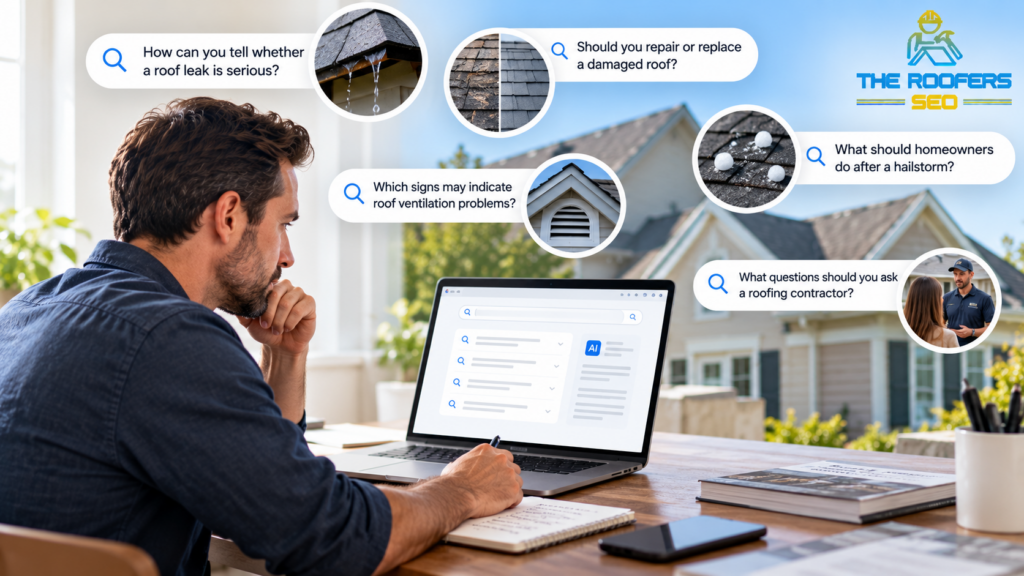
Examples include:
Choose questions that relate to your actual services and expertise. Use customer calls, sales conversations, website search data, and keyword research to understand which issues deserve a dedicated answer.
Do not target every question with a separate article. Related questions can sometimes be addressed in one comprehensive guide, provided the page remains clear and easy to navigate.
A common content mistake is delaying the answer until several paragraphs of background information have passed. Readers who want a quick explanation may leave before reaching the useful part.
Start each article with a concise, direct answer. Then explain the reasons, exceptions, warning signs, and practical next steps.
For example, an article about roof replacement should explain early that the decision depends on the roof’s overall condition, the extent of damage, repair history, and a professional assessment—not just the age of the roof.
After the direct answer, use descriptive headings to organise supporting information. This structure helps readers scan the page and makes the relationship between the question and the answer easier to understand.
Direct answers do not mean oversimplifying complex issues. They mean giving readers the core information first, followed by the detail needed to use it responsibly.
Generic articles can explain common roofing concepts, but real examples can make your content more useful and distinctive.
Where appropriate, include project summaries that describe the initial problem, inspection findings, recommended work, and completed solution. Add original photographs with meaningful captions and alternative text.
For example, a storm damage case study could explain which roof areas were inspected, what damage was observed, and why certain repairs were recommended. Avoid publishing customer addresses or personal information without permission.
Use evidence you can verify. Do not invent project outcomes, claim certifications you do not hold, or publish statistics without a reliable source.
Content grounded in real work gives homeowners more context for evaluating your experience. It also distinguishes your website from pages that repeat the same general advice.
A roofing website should connect broad educational topics to the services the business provides.
A guide about damaged shingles might link to a roof repair page. An article about deciding between repair and replacement could connect to the relevant service pages. A local storm-preparation guide might direct readers to a storm damage inspection service, if offered.
Use descriptive internal links so visitors understand what they will find. Keep the structure logical: supporting articles should reinforce the service pages, and service pages should answer common questions that influence hiring decisions.
For additional ideas on improving mobile usability and attracting local customers, read our guide on how mobile SEO helps roofing companies generate more leads.
Avoid creating several pages that target nearly identical questions without a clear difference in purpose. Consolidating overlapping content may create a more useful resource.
Search systems need to access and interpret your website’s content. Technical issues can make useful pages harder to discover or use.
Check that important pages can be crawled and indexed, internal links work correctly, and the mobile experience is reliable. Avoid placing essential service details only inside images or inaccessible interactive elements.
Review page speed, navigation, HTTPS security, broken links, and mobile readability. Use an XML sitemap to help search engines discover eligible pages, while remembering that submitting a sitemap does not guarantee indexing.
Structured data can clarify information about your organisation, articles, breadcrumbs, and eligible local business details. Implement only schema that accurately reflects visible page content. Structured data does not guarantee inclusion in AI Overviews.
Technical SEO is a foundation: it helps search systems access the information you have created, but it cannot compensate for content that lacks usefulness or credibility.
A homeowner searching for a roofer needs more than a general explanation of roof damage. They may want a company that works in their area and provides the service they need.
Keep your business information consistent across your website and relevant profiles. Maintain accurate service areas, contact details, business hours, and service descriptions. Encourage honest customer reviews and respond professionally.
Local pages should contain genuine information about the services available in each area. If you have relevant local project examples, use them to demonstrate experience rather than repeating the same city name across generic copy.
Your website should also explain who you serve, which roofing services you provide, and how a homeowner can contact your team. Clear information helps visitors assess whether your company is relevant to their needs.
Roofing advice can depend on materials, weather conditions, building requirements, warranties, and manufacturer recommendations. Review articles regularly to ensure that the information remains accurate and useful.
Update pages when services change, when new project examples become available, or when important details need clarification. Remove outdated claims and replace broken sources.
For subjects involving insurance, building codes, or safety, explain the limits of general advice and direct readers to appropriate professionals or official resources where needed.
Updating a page should improve its value—not merely change its publication date. Add information that answers an unanswered question or helps readers make a better decision.
AI Overview appearances may vary by query, location, device, and time. A page’s absence from one search does not automatically mean the content is poor, and appearing in an AI Overview does not guarantee a lead.
Use Google Search Console and website analytics to monitor relevant queries, impressions, clicks, landing pages, and organic traffic. Also track calls, quote requests, and qualified enquiries.
Review which pages attract the right audience and which topics have strong informational value but weak conversion paths. Improve those pages with relevant internal links, clearer service information, and appropriate calls to action.
Treat AI Overview visibility as one part of a broader search strategy rather than the sole measure of success.
No. Google controls which sources appear and how AI Overviews are generated. Roofing companies can improve content quality and accessibility, but no ethical SEO strategy can guarantee placement.
No. Traditional rankings and AI Overview source selection are not identical. Relevant, accessible, helpful content may support visibility, but inclusion is not guaranteed.
Not necessarily. Combine closely related questions when one comprehensive page answers them well. Create separate pages when the questions have distinct intent and require meaningfully different information.
Structured data can help search engines interpret eligible information when implemented correctly. It does not guarantee an AI Overview appearance or special search treatment.
Monitor organic impressions, clicks, relevant queries, lead-generating pages, calls, quote requests, and qualified leads. Review AI search visibility where practical, but judge the strategy by its overall value.
Ranking in Google AI Overviews is not about manipulating search systems or publishing large volumes of repetitive content. It is about answering genuine questions, demonstrating first-hand expertise, maintaining accurate information, and creating a website that serves homeowners effectively.
When your content connects useful advice with clear service information and a strong local presence, you build a better foundation for organic visibility, customer trust, and lead generation.
Plan a tailored strategy with The Roofers SEO, a specialist in SEO and digital marketing for roofing companies, and focus on turning relevant search visibility into meaningful business opportunities.